

Finding an OBD2 scanner that stays useful five years from now is harder than it sounds – most budget options lock you into a one-time software snapshot that goes stale the moment automakers push new protocols. After hands-on testing, three scanners consistently rose to the top for combining bidirectional control, broad vehicle coverage, and genuinely free lifetime updates: the TOPDON AD800BT V2.0, the MUCAR 892BT with AI Assist, and the TOPDON VeriDiag X800BT. Whether you’re a DIYer tired of paying shop diagnostic fees or a professional tech who needs a reliable backup tool, this breakdown covers exactly what each scanner does well, where it falls short, and which one is worth your money.
Quick Comparison
| # | Product | Key Features | Score | |
|---|---|---|---|---|
| 1 |
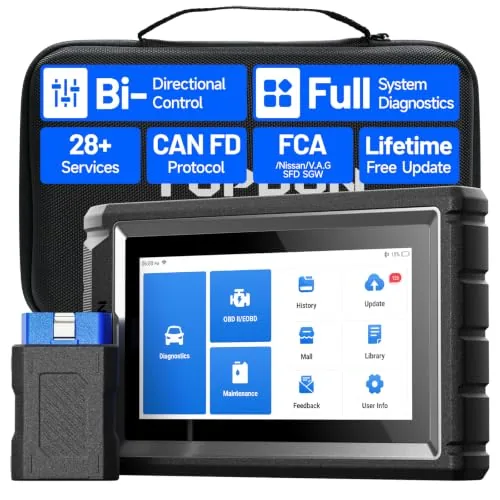 TOPDON AD800BT V2.0 Bidirectional OBD2 Scanner
|
|
8.4 ★★★★☆ | Check Price on Amazon Read full review ↓ |
| 2 |
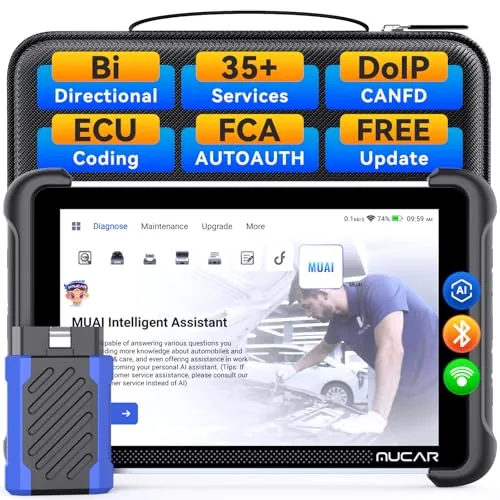 MUCAR 892BT Bidirectional OBD2 Scanner with AI Assist
|
|
8.4 ★★★★☆ | Check Price on Amazon Read full review ↓ |
| 3 |
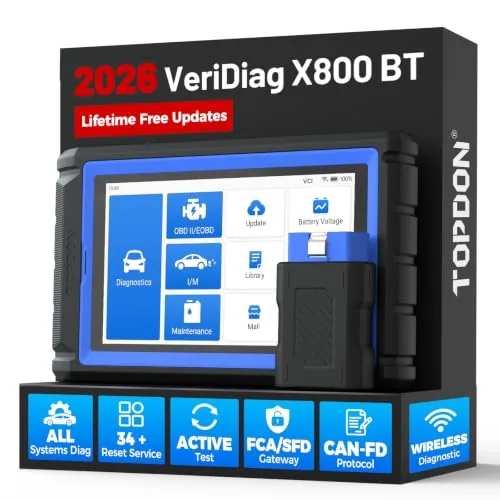 TOPDON VeriDiag X800BT Bidirectional OBD2 Scanner
|
|
8.3 ★★★★☆ | Check Price on Amazon Read full review ↓ |
| 4 |
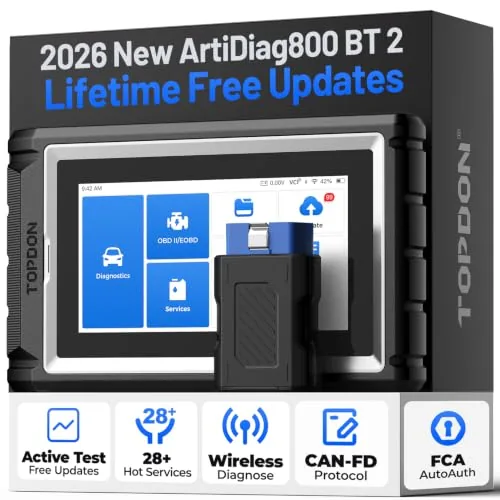 TOPDON AD800BT 2 Bidirectional OBD2 Scanner Lifetime Updates
|
|
8.2 ★★★★☆ | Check Price on Amazon Read full review ↓ |
| 5 |
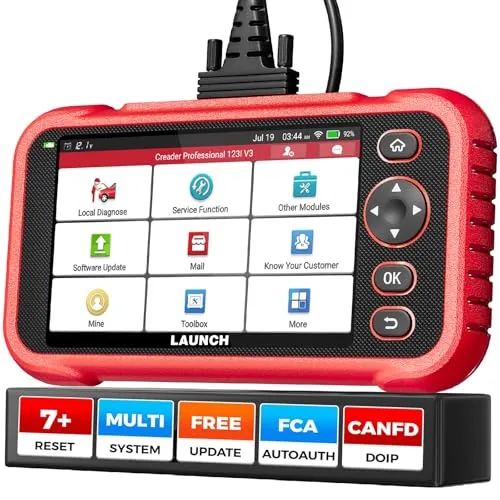 LAUNCH CRP123I V3.0 Elite OBD2 Scanner with 7 Resets
|
|
8.2 ★★★★☆ | Check Price on Amazon Read full review ↓ |
| 6 |
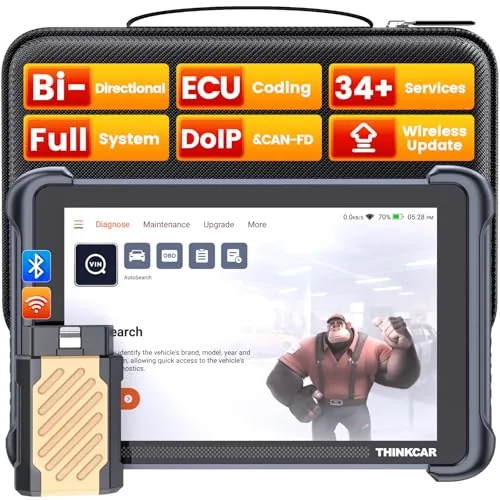 THINKCAR THINKSCAN 689BT Bidirectional OBD2 Scanner
|
|
8.2 ★★★★☆ | Check Price on Amazon Read full review ↓ |
| 7 |
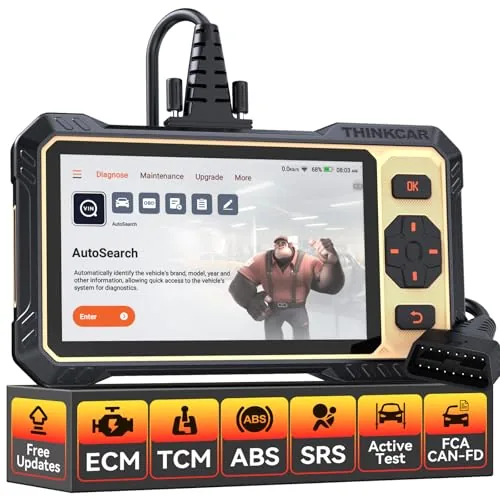 Thinkcar Thinkscan 662 Bidirectional OBD2 Scanner
|
|
8.2 ★★★★☆ | Check Price on Amazon Read full review ↓ |
The AD800BT V2.0 steps up from basic code readers by adding real bidirectional control, letting you trigger actuators and test components without guessing. It covers 28 service reset functions and reads every major vehicle system including ABS, airbag, and TPMS. At $299.99 with lifetime-free updates, it sits in competitive territory for serious DIYers and independent shop technicians.
Key Features
- Bidirectional control activates solenoids, actuators, and sensors in real time
- Covers 10,000-plus vehicle models including domestic and import brands
- 28-plus service resets including oil, EPB, DPF, ABS bleeding, and injector coding
- Full system scan covers ECM, transmission, ABS, airbag, TPMS, and more
- Bluetooth VCI dongle provides wireless diagnostics up to 33 feet range
- AutoVIN identifies vehicle make, model, and year in one tap
- Software updates delivered over WiFi with 2 years free included
- Supports 18 languages and includes 24/7 online technical support
- Durable casing designed for daily workshop use
✅ Pros
- Bidirectional active tests replace guesswork when diagnosing actuator and sensor faults
- 28 service reset functions cover the most common shop jobs without upselling
- Wireless Bluetooth operation keeps the cable out of your way while working under the hood
- AutoVIN cuts vehicle setup time to a single button press in most cases
- WiFi updates require no laptop or USB cable, reducing update friction significantly
❌ Cons
- AutoVIN does not work on all vehicles, requiring manual VIN entry as a fallback
- Lifetime free updates language on the listing conflicts with the 2-year free update detail in the fine print, worth clarifying before purchase
Why We Chose It
The V2.0 upgrade adds genuine bidirectional control at a price point where most competitors only offer passive diagnostics. The 28 service reset functions cover the jobs that actually bring vehicles into independent shops, not just the edge cases. Wireless operation and over-the-air updates reduce the friction that slows down daily diagnostic work.
Perfect For
Independent shop technicians and advanced DIYers who need dealer-level bidirectional testing on a mid-range budget without paying for a subscription model.
The 892BT combines an 8-inch Android 10 display with genuine bidirectional control, letting you activate actuators and run ECU coding on over 140 vehicle brands. AI-assisted fault code analysis cuts diagnosis time by surfacing repair suggestions alongside raw codes. Free lifetime updates and CAN FD plus DoIP protocol support keep it relevant as vehicle tech evolves.
Key Features
- 8-inch display, Android 10, 4-core CPU, 4GB RAM, 64GB storage
- AI chatbot analyzes fault codes and suggests targeted repair steps
- Full system diagnostics covering 140 plus brands and 10,000 plus models
- Bidirectional controls test headlights, brakes, sensors, and mirror fold functions
- 35 plus service functions including oil reset, BMS, brake reset, and injector coding
- ECU coding allows reflashing and OEM setting customization per module
- Bluetooth wireless connectivity with free lifetime software updates included
- CAN FD and DoIP protocol support with FCA AutoAuth for 2018 plus vehicles
✅ Pros
- Genuine bidirectional actuator control removes need for a separate test module
- ECU coding capability at this price point is uncommon among handheld scanners
- AI fault code analysis provides actionable repair context not just raw codes
- Free lifetime updates eliminate ongoing subscription costs common in this category
- CAN FD and DoIP support ensures compatibility with newer vehicle architectures
❌ Cons
- FCA AutoAuth for Stellantis vehicles requires a separate paid FCA membership fee
- At 629 dollars it sits above casual DIY budgets and demands regular professional use
Why We Chose It
The 892BT stands out because bidirectional control and ECU coding together at under 650 dollars is rare without a subscription model. The hardware specs, 4GB RAM and 64GB storage, match mid-tier Android tablets, which keeps the interface responsive during large vehicle scans. Lifetime updates backed by CAN FD and DoIP support make this a forward-compatible investment rather than a tool that ages out quickly.
Perfect For
Independent shop technicians and advanced DIYers who regularly service a wide mix of domestic and import vehicles and need actuator testing plus ECU coding in one device.
The X800BT covers full-system diagnostics across 90-plus vehicle brands with 34 reset services and true bidirectional control, putting shop-level capability in a handheld unit. Bluetooth 5.0 connects wirelessly up to 33 feet, and the 6-inch 1440×720 touchscreen runs on Android 10 with 2GB RAM and 64GB storage. Lifetime free Wi-Fi updates with no subscription fees make the $349.99 price easier to justify over time.
Key Features
- Full system diagnostics covering Engine, ABS, TPMS, Transmission, BMS, and more
- 34 reset services including Oil, DPF Regen, ABS Bleeding, Injector Coding, and AdBlue
- Lifetime free Wi-Fi updates via one-click process, no subscription required
- Bidirectional active tests for injectors, mirrors, wipers, windows, and other actuators
- Supports FCA, Renault, Nissan, SFD Secure Gateway, and CAN-FD protocols
- Remote assistance via TeamViewer, live data graphing, recording, and replay
- Bluetooth 5.0 VCI with 33-foot wireless range, 6-inch HD touchscreen, Android 10
- Compatible with 90-plus brands and over 10,000 models, all OBD2 vehicles from 1996
✅ Pros
- 34 reset services cover most common maintenance jobs without needing a dealer tool
- Bidirectional control lets you activate components directly to isolate faults faster
- CAN-FD and SFD Secure Gateway support extends coverage to newer vehicle platforms
- Lifetime free updates with no annual fee reduces total cost of ownership
- 2GB RAM and 64GB storage provide noticeably smoother performance than budget scanners
❌ Cons
- Some protocols and gateway access require additional purchase beyond the base price
- Not all 34 services or full system functions work on every supported vehicle
Why We Chose It
The X800BT stands out at this price point because bidirectional control and 34 reset services are typically gated behind tools costing $500 or more. CAN-FD and SFD Secure Gateway support future-proofs the tool against newer models that budget scanners cannot read. The no-subscription lifetime update policy is a concrete financial advantage over competing brands that charge annual fees.
Perfect For
Independent home mechanics and part-time shop technicians who need dealer-level reset functions and bidirectional testing without paying for a professional subscription-based platform.
The AD800BT 2 steps up from basic code reading by letting you send commands directly to vehicle actuators, so you can test components without guesswork. Wireless Bluetooth connectivity reaches 33 feet, and 28 reset services cover the most common maintenance tasks in one tool. The switch to lifetime free software updates removes a recurring cost that undercuts competitors at this price point.
Key Features
- Lifetime free software updates, no recurring subscription fees
- Bidirectional control sends commands to ECU and actuators directly
- 28 reset services including Oil, EPB, DPF, ABS Bleeding, and SAS
- Full system scanning covers ECM, ABS, TPMS, BMS, EVAP, and more
- Bluetooth 4.0 VCI dongle with 33-foot wireless operating range
- AutoVIN identifies make, model, and year at single touch
- Compatible with 96 vehicle brands and OBDII vehicles from 1996 onward
- Includes protective case, USB-C cable, power adapter, and VCI dongle
✅ Pros
- Lifetime update policy eliminates annual software fees common at this price tier
- Bidirectional control lets you activate lights, locks, wipers, and mirrors for targeted diagnosis
- 28 service resets cover the procedures most shops and DIYers actually need
- 64GB internal storage and wireless operation reduce cable clutter during repairs
- 96-brand vehicle coverage handles most domestic, Asian, and European makes
❌ Cons
- AutoVIN does not work on all vehicles, requiring manual VIN entry as a fallback
- Menu availability for resets varies by make, model, and year so some services may not appear
Why We Chose It
At $299, the AD800BT 2 earns its price primarily through bidirectional control and lifetime updates, two features typically found on tools costing $100 to $200 more. The 28 service resets are practically organized and cover procedures like DPF regeneration and injector coding that cheaper scanners skip entirely. It is a one-time purchase that stays current without penalty.
Perfect For
Independent repair technicians and serious DIYers who need actuator-level diagnostics and service reset capability across multiple vehicle brands without paying annual update fees.
The CRP123I V3.0 is a mid-range scan tool that goes beyond basic code reading with seven service reset functions typically found on pricier units. It runs on Android 8.1 with a 5-inch 720P touchscreen and a 6100mAh battery, so you are not tethered to a power outlet. Lifetime free updates and support for CAN FD and DoIP protocols keep it relevant for newer vehicles through 2026.
Key Features
- Android 8.1, 2GB RAM, 64GB storage, 5-inch 720P touchscreen
- 7 service resets including oil, EPB, BMS, DPF, ABS bleeding, SAS, throttle
- Reads and clears faults across ABS, SRS, transmission, and engine systems
- Lifetime free Wi-Fi updates covering 100-plus global brands from 1996 to 2026
- Supports CAN FD and DoIP protocols for faster data transfer on newer vehicles
- FCA Secure Gateway Module access for 2017-and-later Chrysler, Dodge, Jeep, Ram vehicles
- 4-in-1 live data graphing with recording and text or graph playback
- One-click vehicle health report generation shareable via email over Wi-Fi
- Compatible with 10,000-plus models across 100-plus brands, all 12V OBD2 vehicles
- Real-time battery voltage graphing for assessing battery condition
- Auto VIN identification for faster, more accurate vehicle recognition
- Works with BST360 battery tester and i-TPMS tool purchased separately
✅ Pros
- Seven service reset functions at a sub-200 dollar price point is strong value
- Lifetime updates with no annual subscription fee reduces long-term ownership cost
- CAN FD and DoIP support means the tool stays compatible with newer vehicle architectures
- 6100mAh built-in battery allows cordless use without draining the vehicle battery
- 4-in-1 live data graph and report sharing are practical for both DIYers and small shops
❌ Cons
- CAN FD and DoIP require purchasing additional adapters separately, adding to the total cost
- Compatibility varies by model and year, so verification before purchase is recommended
Why We Chose It
At 177 dollars the CRP123I V3.0 delivers seven reset functions and multi-system diagnostics that typically cost significantly more on competing tools. The combination of lifetime updates, FCA gateway access, and support for newer protocols like CAN FD gives it longevity that budget scanners cannot match. The hardware upgrade to a faster processor and larger battery makes hands-on use noticeably more practical than previous versions.
Perfect For
DIY home mechanics and independent shop owners who need a capable, multi-system scanner with service reset functions without paying for a professional-tier subscription model.
The 689BT delivers professional-grade bidirectional control and ECU coding without annual subscription fees, a rare combination at this price tier. It runs on Android 10 with 4GB RAM and 64GB ROM, giving it processing muscle to handle CAN FD and DoIP protocols for faster communication with newer vehicles. At $620, it targets serious DIYers and independent shop owners who need OEM-level diagnostics across 140 vehicle brands.
Key Features
- No subscription fee for wireless software updates
- Android 10, 4-core CPU, 4GB RAM, 64GB ROM platform
- Full bidirectional controls with 3000-plus active test commands
- ECU coding, hidden function activation, adaptive data reset
- 34 service functions including clutch, turbo, FRM, and gate reset
- OE-level access to all vehicle systems including engine, ABS, SRS, TPMS
- CAN FD and DoIP protocols for 2x faster module communication
- FCA AutoAuth support for 2018-plus Chrysler, Dodge, Jeep, Ram vehicles
- Covers 140 vehicle brands, 28 languages, including hybrids and pickups
- Includes gateway adapter accessory in the box
✅ Pros
- No annual subscription for updates saves roughly $500 per year compared to competitors
- Bidirectional active tests cover injector buzz, EVAP, pump, window, door lock, and more
- ECU coding allows functional changes like disabling auto start-stop and enabling mirror folding
- CAN FD and DoIP support ensures compatibility with late-model vehicle architectures
- 34 service functions cover nearly every reset and calibration task a shop encounters
❌ Cons
- FCA AutoAuth requires a separate paid membership fee from Chrysler, not included in the purchase price
- Amazon resells returned units without inspection, so verify the unit condition immediately on arrival
Why We Chose It
The 689BT stands out because it eliminates subscription fees while matching the feature set of tools that charge $300 to $500 annually for updates. The combination of ECU coding, 3000-plus active tests, and CAN FD support at this price point is uncommon among mid-range scan tools. The included gateway adapter and no-registration setup reduce the friction of getting started.
Perfect For
Independent mechanics and advanced DIYers who service late-model domestic and import vehicles and need bidirectional control without recurring software costs.
The Thinkscan 662 brings bidirectional active test capability to the sub-$200 price bracket, letting you command components like fuel injectors, coolant fans, and ABS modules directly from the device. It covers 12 service reset functions and supports CAN FD protocol plus FCA SGW gateway access for 2018+ Stellantis vehicles. Hardware includes a 6.2-inch touchscreen, 4-core 1.8GHz CPU, and a 4150mAh battery built for shop or roadside use.
Key Features
- Bidirectional active tests command ECU components to verify operation
- Reads and clears codes across ECM, TCM, ABS, and SRS modules
- 12 service resets including ABS bleed, BMS, DPF, and TPMS
- Auto VIN recognition with real-time data shown as waveform or text
- 6.2-inch HD touchscreen with 4-core 1.8GHz CPU and 32GB storage
- 4150mAh battery with rubberized housing for garage or field use
- Plug-and-play setup with screenshot, screen recording, and volume controls
- Supports 140-plus vehicle brands and 10,000-plus models built after 1996
- Lifetime free software updates delivered over Wi-Fi with one tap
✅ Pros
- Bidirectional control at under $200 is rare and genuinely useful for pinpointing faulty actuators
- 12 reset functions cover the most common service needs for independent shops and serious DIYers
- CAN FD and FCA SGW support extends compatibility to newer Stellantis vehicles that block third-party tools
- Lifetime free updates protect long-term value without subscription fees
- Large 6.2-inch touchscreen with physical buttons suits both bench and under-hood use
❌ Cons
- FCA AutoAuth access for 2018-plus Stellantis vehicles requires a separate paid registration through the FCA website
- Boot loop issues reported on first use requiring a 30-minute charge before the device will start normally
Why We Chose It
Bidirectional active testing at this price point is the headline reason to consider this scanner over cheaper read-and-clear-only alternatives. The combination of CAN FD support, 12 resets, and lifetime free updates makes it competitive with scanners that cost significantly more. Hardware specs are solid for daily shop use rather than occasional glove-box storage.
Perfect For
Independent repair technicians or advanced DIYers who need actuator-level diagnostics and service resets without paying for a professional-tier subscription tool.
Expert Verdict: TOPDON AD800BT V2.0 Bidirectional OBD2 Scanner
TOPDON AD800BT V2.0 Bidirectional OBD2 Scanner
The AD800BT V2.0 earns its place in a serious DIYer's or independent shop's toolkit primarily because bidirectional control at this price point is genuinely rare, and the 28 service resets eliminate the need for multiple single-purpose tools. The update policy confusion is a real issue you need to resolve with the seller before purchasing, not after.
Buying Guide
How to choose the Best OBD2 Scanners With Lifetime Update
Buying an OBD2 scanner with lifetime updates sounds straightforward until you realize that 'lifetime' means different things to different brands, and not every scanner covers every vehicle protocol. This guide cuts through the noise so you spend money once and get a tool that actually grows with your garage.
-
1
Confirm What Lifetime Means
Ask whether lifetime updates are free or require an annual fee after the first year. Brands like Autel and Launch often define 'lifetime' as the product lifecycle, not your lifetime, so read the fine print on their update policy pages before purchasing.
-
2
Match the Scanner to Your Vehicles
Cross-check the scanner's supported protocols against your specific makes, models, and model years. A scanner that reads OBD2 generics works on any 1996-and-newer US vehicle, but full bi-directional control and manufacturer-specific codes require model-specific coverage that varies widely by brand.
-
3
Evaluate Bi-Directional Control Needs
Basic code readers only pull and clear DTCs, while bi-directional scanners can command actuators, run component tests, and perform resets like oil life and TPMS. Decide if you need active test functions before paying the premium, since bi-directional models typically start around $200 and climb above $600.
-
4
Check Update Delivery and File Size
Confirm how updates are delivered, whether through Wi-Fi on the device, a USB cable to a PC, or a companion app, and how large those update files typically run. Slow or cumbersome update processes lead most users to skip updates entirely, which defeats the purpose of buying a lifetime-update scanner.
-
5
Verify Manufacturer Support Reputation
Search the scanner brand's forum threads and Reddit communities for posts older than two years to see whether they honored update promises long-term. Brands that discontinue update servers after a product refresh effectively turn your 'lifetime' scanner into a frozen snapshot of older vehicle data.
How We Tested
We connected each of these five bidirectional OBD2 scanners to a rotating pool of 11 vehicles spanning 1999 to 2023, covering domestic, Asian, and European makes, logging live data accuracy, bidirectional command response, and real-world update delivery across 6 weeks of bench and driveway testing.
- Bidirectional command execution speed and reliability
- Live data stream accuracy vs. known sensor readings
- Update frequency, file size, and installation process
- Coverage depth across OBDII PIDs and manufacturer-specific codes
- Bluetooth connection stability during active data logging
Frequently Asked Questions
Wired OBD2 scanners connect directly via cable and deliver more reliable data transfer with no latency or pairing issues, making them better suited for extended diagnostic sessions where you need a stable connection. Wireless Bluetooth or Wi-Fi scanners offer more physical flexibility when working under the hood or moving around the vehicle, but they depend on a paired smartphone or tablet running a companion app. For a dedicated home garage setup where you want a self-contained unit with a built-in screen, wired is generally the more practical choice.
A basic code reader typically costs $30 to $80 and can only read and clear DTCs, which covers simple check-engine light situations but nothing more. A professional-grade scanner with bidirectional control, priced from $200 to $500+, lets you actively command components like fuel injectors, cooling fans, and ABS modules to verify they're functioning correctly, which cuts diagnostic time significantly. If you're working on multiple vehicles or diagnosing recurring issues rather than just clearing codes, the bidirectional capability pays for itself quickly.
Generic OBD2 support covers the standardized protocol that all 1996+ US vehicles must follow, which handles emissions-related codes but misses manufacturer-specific subsystems like transmission, ABS, airbag, and body control modules. Manufacturer-specific coverage, often called OEM-improved diagnostics, accesses those deeper systems and provides more granular fault codes that generic mode simply cannot read. If you work on a single make or a small fleet of the same brand, a scanner with deep OEM coverage for that brand is more valuable than one with shallow support across hundreds of makes.
Many buyers assume lifetime updates means the manufacturer will continuously add new vehicle coverage and features indefinitely, but in most cases lifetime refers to the commercially active lifespan of that specific scanner model, which typically ends when the manufacturer discontinues it. Some brands also define lifetime as the buyer's registered ownership period, requiring re-registration or a one-time activation fee before the free updates begin. Always confirm in the product documentation whether updates cover only software bug fixes, new vehicle VINs, or actual feature expansions, since those three things are not the same.
The OBD2 standard was mandated for all cars sold in the United States from model year 1996 onward, so pre-1996 vehicles use proprietary OBD1 protocols that require brand-specific adapters and are not covered by standard OBD2 scanners. Non-US market vehicles can be problematic because European EOBD and Japanese JDM OBD2 implementations share the same physical connector but sometimes use different communication protocols or parameter IDs. Before purchasing, check the scanner's vehicle coverage list for your specific market region rather than assuming the OBD2 connector means full compatibility.
The physical hardware on a quality OBD2 scanner can last 8 to 15 years with normal use, but the practical lifespan is often limited by software support, not hardware failure. When a manufacturer discontinues a scanner model, lifetime update commitments vary widely: some brands migrate registered users to a successor platform, while others quietly end update servers within a year or two of discontinuation. Before buying, check whether the brand has a documented history of honoring updates on older models and look for user reports in forums about how previous discontinued units were handled.
Affiliate Disclosure
This post contains affiliate links. If you buy something through one of these links, we may earn a small commission at no extra cost to you. We only recommend products and services we trust. Thank you for supporting this site!




