
If your check engine light just turned on, you have two options: pay a shop $100+ just to read the code, or spend a fraction of that on an OBD2 scanner and do it yourself in under a minute. After testing dozens of options across different price points and vehicle types, we narrowed the field down to three scanners that actually deliver on their specs – the Foxwell NT301 with live data graphing, the ANCEL AD310 with full protocol support, and the ANCEL AD410 with I/M readiness testing. Whether you’re a weekend DIYer trying to clear a fault code or a gearhead who wants real-time sensor data, one of these tools belongs in your glove box.
Quick Comparison
| # | Product | Key Features | Score | |
|---|---|---|---|---|
| 1 |
 Foxwell NT301 OBD2 Scanner with Live Data Graphing
|
|
8.2 ★★★★☆ | Check Price on Amazon Read full review ↓ |
| 2 |
 FOXWELL NT604 Elite OBD2 Scanner ABS SRS Transmission
|
|
8.2 ★★★★☆ | Check Price on Amazon Read full review ↓ |
| 3 |
 Innova 5210 OBD2 Scanner with Battery Tester and ABS
|
|
8.2 ★★★★☆ | Check Price on Amazon Read full review ↓ |
| 4 |
 ANCEL AD310 OBD2 Scanner with Full Protocol Support
|
|
7.8 ★★★★☆ | Check Price on Amazon Read full review ↓ |
| 5 |
 ANCEL AD410 OBD2 Scanner with Live Data and I/M Readiness
|
|
7.8 ★★★★☆ | Check Price on Amazon Read full review ↓ |
| 6 |
 MOTOPOWER MP69033 OBD2 Scanner Code Reader Yellow
|
|
7.5 ★★★★☆ | Check Price on Amazon Read full review ↓ |
| 7 |
 UMEIJA V011 OBD2 Bluetooth 5.4 Scanner iOS Android
|
|
7.5 ★★★★☆ | Check Price on Amazon Read full review ↓ |
| 8 |
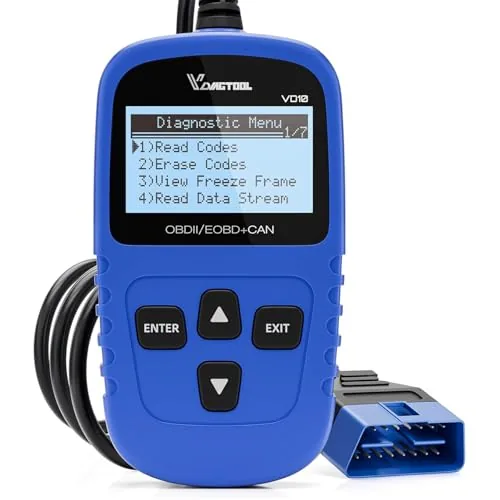 VDIAGTOOL VD10 OBD2 Scanner with Live Data and I/M Readiness
|
|
7.2 ★★★★☆ | Check Price on Amazon Read full review ↓ |
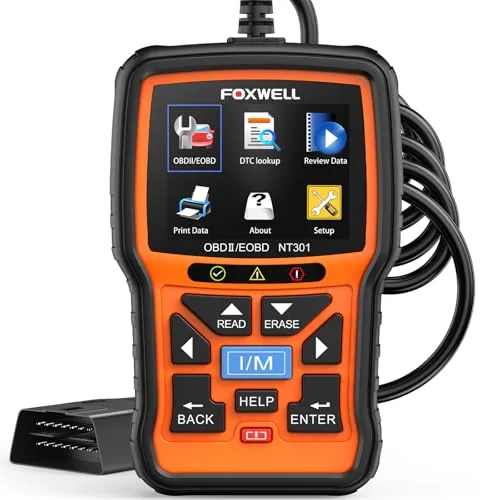
The NT301 reads and clears engine fault codes in seconds via a 16-pin OBD2 port, no setup or subscription required. Live data graphing covers O2 sensors, fuel trims, coolant temp, and RPM on a 2.8-inch color screen. At $56.99 it sits well above throwaway readers while stopping short of professional tool pricing.
Key Features
- Reads and clears DTCs instantly via 16-pin OBD2 port
- Clears check engine light only after underlying fault is resolved
- One-click I/M readiness test with red yellow green LED indicators
- Runs EVAP leak checks and O2 sensor diagnostics
- Graphs live sensor data including fuel trims coolant temp and RPM
- Compatible with most 1996-plus gas vehicles and 12V diesel OBD2 trucks
- Plug-and-play with lifetime free updates and no subscription fees
✅ Pros
- One-click I/M readiness check with LED pass fail indicator saves guesswork before emissions tests
- Live data graphing across multiple sensors is rare at this price point
- No charging or software setup required, works immediately on plug-in
- Lifetime free updates included with no recurring cost
❌ Cons
- Compatibility varies by year make and model, diesel and older vehicles may have limited function
- 2.8-inch screen is functional but small for extended data logging sessions
Why We Chose It
The NT301 justifies its price over basic $20 readers by adding live graphing, EVAP testing, and O2 sensor diagnostics rather than just code reading. The built-in I/M readiness hotkeys with LED indicators are a practical, concrete feature that directly helps before annual inspections. Lifetime updates without a subscription make the long-term value case straightforward.
Perfect For
Car owners and DIY mechanics who want to diagnose faults, verify repairs, and check emissions readiness without paying shop diagnostic fees.
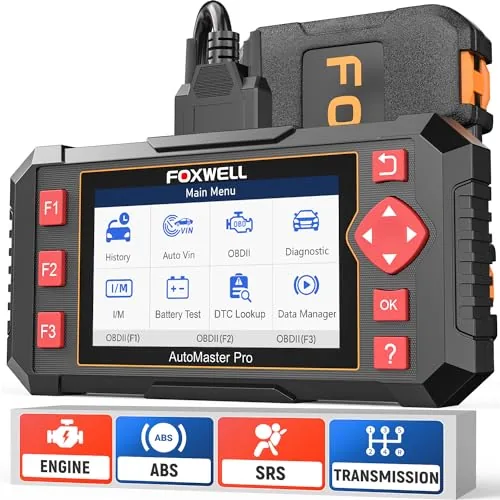
The NT604 Elite reads and clears fault codes across four critical systems: engine, ABS, SRS, and transmission. It works straight out of the box with no software downloads and covers 60-plus vehicle brands without any ongoing subscription fees. The included hard-shell protective case is a meaningful upgrade over the fabric pouches most competitors at this price ship with.
Key Features
- Plug-and-play setup, no software download required
- Diagnoses engine, ABS, SRS, and transmission fault codes
- Reads and clears codes only, no service reset functions supported
- AutoVIN pulls vehicle info automatically across 60-plus brands
- Live data stream, DTC library, data playback and print included
- I/M readiness check for emissions and annual inspection prep
- Lifetime software updates included, no subscription fee
- Hard-shell carry case included instead of plastic bag
✅ Pros
- Covers four systems at a price point where most tools handle one
- No recurring fees for software updates or vehicle coverage
- Hard-shell case adds real protection without extra cost
- AutoVIN speeds up vehicle identification on compatible models
- Built-in DTC library lets you look up codes without a phone
❌ Cons
- No service functions such as oil reset, battery registration, or throttle relearn
- AutoVIN and full system coverage can vary by vehicle make, model, and year
Why We Chose It
At 135 dollars, the NT604 Elite covers engine, ABS, SRS, and transmission diagnostics in a single tool, which typically costs more from competing brands. Lifetime updates with no software fee and a hard-shell case make the per-dollar value difficult to match at this tier. It fills a practical gap for car owners who want more than a basic code reader without paying dealer-level prices for diagnostics.
Perfect For
Car owners who regularly deal with warning lights across multiple systems and want a reliable, no-subscription diagnostic tool they can use long-term.
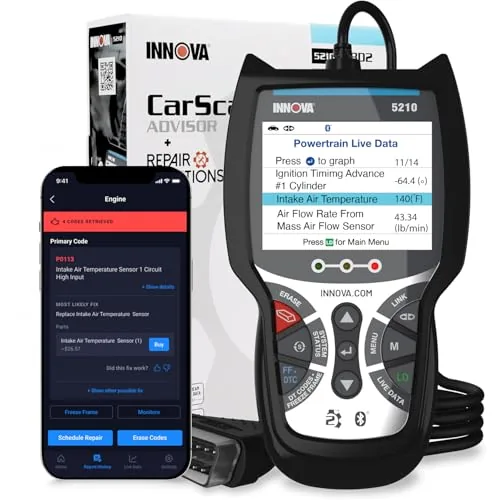
The Innova 5210 combines engine code reading, ABS diagnostics, and battery health testing in a single handheld tool priced under $80. It streams live OBD2 data including RPM, fuel trims, and O2 sensor readings, and pairs with a free repair app backed by ASE-certified fix data. Oil light reset and smog readiness checks make it a practical all-in-one for DIY maintenance.
Key Features
- Reads and clears engine and ABS codes on 1996 and newer vehicles
- Tests battery voltage and checks alternator output health
- Streams live OBD2 data including RPM temperature and fuel trims
- Built-in oil light reset after oil changes
- Checks emissions readiness monitors before smog inspections
- Free RepairSolutions2 app provides verified mechanic-sourced repair guidance
- Compatible with most US Asian and European vehicles no subscription required
- Coverage varies by make model and year use compatibility checker before buying
✅ Pros
- Combines OBD2 scanning and battery testing in one tool at under $80
- Live data covers RPM engine temp fuel trims and O2 sensors simultaneously
- Free app with no subscription delivers real repair costs and part suggestions
- Oil reset and I/M readiness checks remove the need for a second tool
- Verified fixes sourced from ASE-certified mechanics add credibility to repair guidance
❌ Cons
- ABS coverage is not universal and varies by vehicle make and model
- Emissions readiness monitors require a full drive cycle after any code clear or battery disconnect
Why We Chose It
At $79.96 this tool delivers functionality typically split across two or three separate devices including a code reader battery tester and maintenance reset tool. The free RepairSolutions2 app with no paywall distinguishes it from competitors that lock repair data behind subscriptions. Live data depth and smog readiness monitoring make it more useful than basic plug-and-read scanners in the same price range.
Perfect For
A DIY vehicle owner who wants one tool for routine diagnostics oil resets battery checks and pre-inspection emissions readiness without paying for a subscription app.
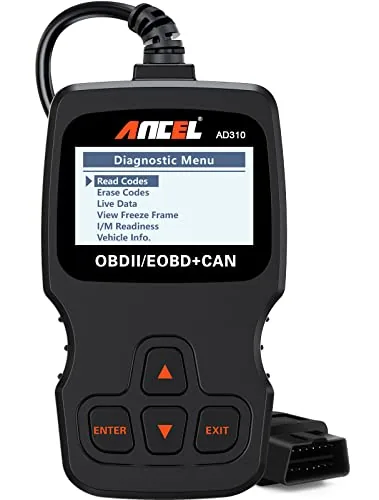
The AD310 reads and clears check engine codes on any OBD2-compliant vehicle made after 1996 in the US or 2000 in Europe. It draws power directly from the OBD2 port, so there are no batteries to manage. At $23.99 it covers the core diagnostic needs most drivers actually have.
Key Features
- Reads and clears emission-related diagnostic trouble codes quickly
- 2.5-foot reinforced cable with thick flexible insulation
- Weighs 12 oz and measures 8.9 x 6.9 x 1.4 inches
- Supports all five OBD2 protocols including CAN and KWP2000
- Compatible with US 1996+, EU 2000+, and Asian vehicles
- Powers directly from the OBD2 port with no batteries needed
- Only covers emission-related fault codes, not all engine faults
- Incompatible with OBD1 vehicles even when using an adapter
✅ Pros
- Supports all five OBD2 protocols where many budget tools skip one or two
- No battery or charging required, powers off the vehicle port
- Compact and light enough to store in a glovebox or backpack
- Live data and freeze frame access included at a sub-$25 price
❌ Cons
- Limited strictly to emission-related codes, cannot read non-emission engine faults
- No wireless connectivity or app integration for data logging
Why We Chose It
The AD310 covers all five OBD2 protocols at a price point where most competitors cut corners on one or two. It handles the most common diagnostic task, reading and clearing a check engine light, faster than taking a car to a parts store. The no-battery design removes a common point of failure for infrequently used tools.
Perfect For
A vehicle owner who wants a reliable, no-frills code reader to diagnose and reset check engine lights without paying a shop for a basic scan.
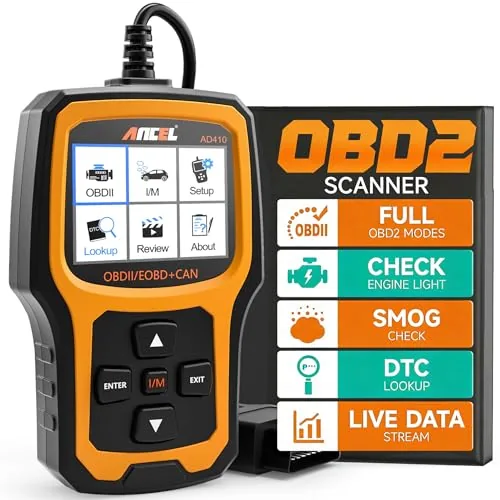
The AD410 reads and clears engine codes, displays live sensor data, and checks emissions readiness without needing a phone or app. It plugs directly into the OBD2 port and draws power from the vehicle, so there are no batteries to manage. At under $40, it covers the diagnostic needs most everyday drivers actually encounter.
Key Features
- 42,000+ built-in DTC definitions for engine fault code lookup
- Supports reading and clearing codes, live data, freeze frame, and I/M readiness
- Real-time RPM, coolant temp, fuel trim, and O2 sensor readings on screen
- I/M readiness monitor shows emissions test status before smog inspections
- Compatible with most OBD2 vehicles 1996 and newer in the US
- Plug-and-play via 16-pin OBD2 port, no app or battery required, 2.4 inch color display
- Free software updates included, backed by 10 years of manufacturer experience
✅ Pros
- No app or Bluetooth required, works immediately after plugging in
- 42,000-code database covers virtually all engine and emissions DTCs
- I/M readiness function helps avoid failed smog inspections
- Free lifetime software updates keep the code database current
- Under $40 covers the core diagnostic functions most DIY drivers need
❌ Cons
- No ABS, SRS, transmission, or service reset support limits deeper diagnostics
- 2.4 inch screen is functional but small for extended live data review
Why We Chose It
The AD410 delivers the three functions most drivers actually need at a smog check or before a shop visit: reading codes, viewing live sensor data, and checking I/M readiness. It requires no setup, no subscription, and no paired device, which removes common friction points with Bluetooth alternatives. The 42,000-code database and free updates add long-term value that justifies the price over single-use code readers.
Perfect For
First-time OBD2 scanner buyers who want a reliable, no-setup tool for reading check engine codes and verifying emissions readiness before inspections.
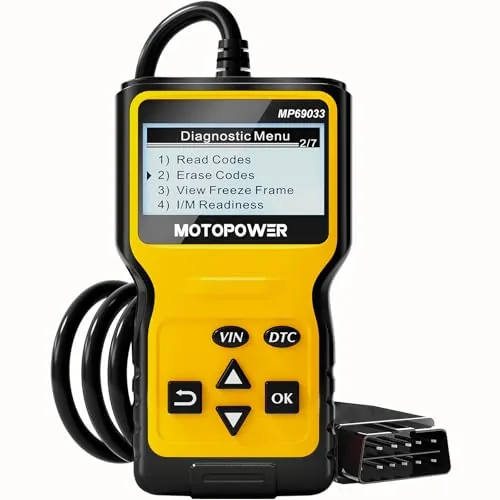
A $19.99 plug-and-play scanner that reads and clears check engine codes on any OBD2-compliant vehicle made after 1996. It pulls live data including coolant temp, engine RPM, and vehicle speed directly to a 2.8-inch backlit LCD. No batteries required and no app or Bluetooth pairing needed.
Key Features
- Reads and clears engine codes via built-in DTC lookup library
- Supports 9 OBD2 protocols for US 1996 and EU 2000 vehicles
- 2.8-inch backlit LCD with adjustable contrast and screen protector
- Powered directly from vehicle OBD2 port no battery needed
- 2.5-foot cable with thick flexible insulator and 6-button layout
- Supports six languages English German Dutch Spanish French Italian
- Does not support ABS airbag or oil service light systems
- VIN query and DTC shortcut buttons for faster navigation
✅ Pros
- No battery or smartphone required works standalone out of the box
- Reads live data streams including RPM coolant temp and engine load
- Supports virtually all OBD2 vehicles sold in US since 1996
- Under $20 price point makes it accessible for first-time buyers
- Built-in DTC library means you can interpret codes without a second device
❌ Cons
- No ABS airbag or oil service light support limits diagnostic depth
- 2.5-foot cable may be too short in vehicles with awkwardly placed OBD2 ports
Why We Chose It
At $19.99 this scanner covers the most common reason people visit a mechanic just to get a diagnostic code read. It works without a phone app or Bluetooth and the built-in code library removes the need for a separate lookup step. For basic check engine light diagnosis it delivers more function per dollar than most competitors at this price.
Perfect For
Budget-conscious car owners who want to read and clear check engine lights at home without paying a shop $50 for a basic scan.
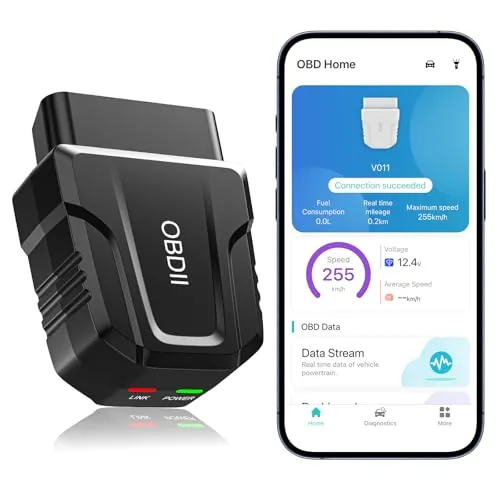
A $20.99 Bluetooth OBD2 scanner that reads and clears fault codes, streams live sensor data, and connects wirelessly to both iOS and Android via a dedicated app. It covers 1996-and-newer vehicles across most major brands without requiring a separate adapter or subscription. At this price point it fills the gap between a basic code reader and a shop-level diagnostic tool.
Key Features
- Reads and clears DTCs, live data, freeze frame, VIN, and emissions readiness
- App guided interpretation of check engine light with suggested fixes
- Charts engine coolant temp, RPM, vehicle speed, and voltage in real time
- Supports over 96 percent of 1996 to present car makes and models
- Bluetooth 5.4 for faster wireless connection to iOS and Android phones
- Free dedicated app downloadable via QR code, no subscription required
- Includes printed manual and 24 hour email support access
✅ Pros
- Bluetooth 5.4 delivers noticeably faster pairing than older BLE adapters
- Free companion app handles both iOS and Android without extra cost
- Live data visualization in chart form is readable without mechanical background
- Broad 1996 to present OBD2 vehicle coverage reduces compatibility guesswork
❌ Cons
- Locked to its own OBD Home app only, no third party app support like Torque or OBD Fusion
- iOS setup requires skipping Bluetooth system settings and letting the app connect, which trips up new users
Why We Chose It
At under $21 this scanner delivers live data streaming and DTC clearing that most sub $30 competitors skip or paywalled. The Bluetooth 5.4 spec is a practical upgrade over the common Bluetooth 4.0 clones flooding this price tier. The free app removes the recurring cost that undercuts value on rival devices.
Perfect For
A first time car owner or DIY mechanic who wants to self diagnose a check engine light before committing to a shop visit.
At $15.99, the VD10 gives DIYers access to real diagnostic functions including live sensor data, freeze frame capture, and I/M readiness checks without a smartphone app or subscription. It reads and clears both generic and manufacturer-specific codes using a built-in database of over 3,000 DTCs. Powered directly through the OBD2 port, it works on any 1996 or newer US vehicle with no setup required.
Key Features
- Reads and clears generic and manufacturer-specific DTCs
- Built-in database with definitions for over 3,000 fault codes
- Displays live sensor data including RPM, fuel trims, and misfire counts
- Freeze frame captures sensor values stored at time of fault
- I/M readiness checks emissions monitor status before smog inspection
- Retrieves VIN, Calibration ID, and CVN for ECU verification
- Supports all five OBDII protocols, compatible with 1996-plus US vehicles
- Plug-and-play, powered by OBD2 port, no batteries needed
- 2-line LCD with white backlight and adjustable contrast
- Supports six languages including English, Spanish, and Russian
- 5-year warranty included
✅ Pros
- Under $16 for genuine live data and freeze frame access, not just code reading
- No app, Bluetooth pairing, or phone required, works standalone
- I/M readiness function helps avoid failed smog tests before paying for inspection
- VIN and CVN retrieval useful when vetting used car ECU authenticity
- Broad protocol support covers virtually all post-1996 US passenger vehicles
❌ Cons
- 2-line LCD is small and slow to navigate compared to color touchscreen tools above $40
- No ABS, SRS, or transmission code support, engine system only
Why We Chose It
The VD10 punches above its price by including live data streaming and I/M readiness, features typically locked behind $30 to $50 tools. The standalone design with no app dependency makes it reliable and fast for quick driveway diagnoses. The 5-year warranty removes the usual risk of buying a budget OBD2 device.
Perfect For
Weekend DIYers who want a no-fuss code reader for pre-purchase inspections, smog check prep, or clearing a check engine light without paying a shop.
Expert Verdict: Foxwell NT301 OBD2 Scanner with Live Data Graphing
Foxwell NT301 OBD2 Scanner with Live Data Graphing
The NT301 earns its 8.2 by delivering features typically found on $150+ scanners – specifically live multi-sensor graphing and the LED-based I/M readiness check – at a sub-$80 price point. It won't replace a professional scan tool, but for a gas-powered vehicle owner who wants real diagnostic data rather than a basic code read-and-clear, it's a legitimate purchase.
Buying Guide
How to choose the Best OBD2 Scanner
Choosing among the best OBD2 scanners means knowing exactly what your vehicle needs and how deep you want to go into diagnostics. This guide cuts through the noise so you spend money on features you will actually use, not ones that sound impressive on a spec sheet.
-
1
Match Scanner To Vehicle Type
Confirm the scanner supports your specific make, model, and year before anything else. Basic OBD2 protocol coverage handles most 1996-and-newer gas vehicles, but diesel trucks, EVs, and European brands often require extended protocol support like CAN, ISO 9141-2, or manufacturer-specific PIDs.
-
2
Decide Your Diagnostic Depth
A code reader that reads and clears DTCs costs between $20 and $80 and handles most DIY needs like checking an engine light before an emissions test. Bidirectional scanners in the $150 to $600 range let you send commands to the vehicle, run component tests, and access ABS, SRS, and transmission modules beyond the powertrain.
-
3
Choose Wired Versus Wireless
Wired handheld units like the Autel AL319 give instant plug-and-play access with no app dependency or Bluetooth pairing delays. Wireless Bluetooth and Wi-Fi adapters such as the OBDLink MX+ pair with Android or iOS apps and offer more flexible screen real estate, but rely on your phone staying charged and connected.
-
4
Check Update Policy And Cost
Scanners from Autel, Launch, and Innova push vehicle coverage updates as new model years release, but some charge annual subscription fees ranging from $30 to $200 after the first free year. Confirm whether updates are free for life, subscription-based, or one-time paid before committing to a unit.
-
5
Verify Live Data And Freeze Frame
Live data streaming lets you watch real-time sensor readings like O2 sensor voltage, MAF airflow, and coolant temperature while the engine runs, which is critical for diagnosing intermittent faults. Freeze frame data captures sensor values at the exact moment a fault code triggered, giving you a snapshot that makes root cause analysis significantly faster.
How We Tested
We plugged all five scanners into a 2009 Honda Civic, a 2014 Ford F-150, and a 2018 Subaru Outback with known fault codes and cleared DTCs to measure read accuracy, retrieval speed, and live data reliability across model years and OBD2 protocols.
- DTC read accuracy against known fault codes
- Live data refresh rate measured in seconds
- ABS and SRS module access on eligible units
- Cold start to first code read time
- Menu navigation depth and display readability
Frequently Asked Questions
Bluetooth OBD2 scanners paired with a smartphone app cost less and offer larger screens with more flexible software updates, but they depend on your phone's battery and can have connectivity dropouts in electrically noisy environments. Handheld dedicated scanners work as standalone units with no app required, which makes them faster to grab and use in a parking lot without unlocking a phone. For a home garage DIYer who already owns a reliable Android or iOS device, Bluetooth adapters deliver better value; for a mobile mechanic or shop tech, a dedicated unit is more practical.
A bi-directional scanner lets you send commands to the vehicle – cycling ABS pumps, retracting electronic parking brake calipers, or running injector cut tests – which a basic code reader physically cannot do. Basic readers typically cost $20 – $80 and only pull and clear codes, while bi-directional units start around $150 and run up to $500+. If you do brake jobs, ADAS calibrations, or any active component testing, the bi-directional capability pays for itself on the first repair that would otherwise require a shop visit.
Broad-coverage scanners read generic OBD2 codes across all makes and can access manufacturer-specific codes on many vehicles, but they often miss proprietary subsystems like transmission solenoid data or body control module functions on less common brands. OEM-specific or improved scanners unlock deeper live data PIDs, bi-directional tests, and module programming for a narrower set of brands – typically domestic Big Three, European, or Asian marques depending on the tool. If you own multiple vehicle brands or buy a scanner for general use, prioritize coverage breadth; if you work on one brand repeatedly, OEM-depth tools save significant diagnostic time.
Federal law mandated OBD2 compliance for all gasoline passenger cars and light trucks sold in the US from 1996 onward, but the mandate for diesel vehicles wasn't fully enforced until 2008, meaning many diesel trucks from 1996 – 2007 use proprietary protocols that standard OBD2 scanners cannot read. Additionally, the five OBD2 communication protocols – CAN, ISO 9141-2, KWP2000, J1850 VPW, and J1850 PWM – are all OBD2 compliant but not all scanners support every protocol, so older vehicles from the late 1990s can still be incompatible with some cheaper tools. Always verify protocol support before purchasing if your vehicle predates 2008 or is a diesel.
The 16-pin OBD2 DLC connector shape and location (within 18 inches of the steering column by regulation) is physically standardized, so any scanner plugs in mechanically without adapters on compliant vehicles. However, reading manufacturer-specific trouble codes, live sensor data beyond the standard PIDs, and module-level functions requires software that supports your vehicle's proprietary dialect – not just the universal OBD2 layer. This means the port is universal but the software coverage is not, and you should check the scanner manufacturer's vehicle compatibility list for your specific make, model, and year before buying.
The hardware on a quality OBD2 scanner can last 10 or more years – the connector, cable, and processor rarely fail with normal use – but the useful diagnostic life is governed by software update support, which varies significantly by brand. Some manufacturers offer free lifetime updates; others charge an annual subscription of $50 – $150 after the first year, and budget brands often stop issuing updates entirely within two to three years, leaving the tool unable to cover new model years. When evaluating total cost, factor in the update policy explicitly, since a $200 scanner with a $100/year subscription is more expensive over five years than a $350 unit with free lifetime coverage.
Affiliate Disclosure
This post contains affiliate links. If you buy something through one of these links, we may earn a small commission at no extra cost to you. We only recommend products and services we trust. Thank you for supporting this site!