

After testing dozens of professional-grade scan tools, the Launch X431 lineup consistently earns its reputation among independent mechanics and serious DIYers who need dealer-level diagnostics without the dealer-level price tag. The best Launch X431 scanners – including the PRO3 V+ Elite J2534, the PRO3S+ V5.0, and the CRP919XBT – differ significantly in coverage, bidirectional capability, and wireless functionality, so the right choice depends entirely on your vehicle mix and how you work. This breakdown cuts through the spec sheet noise to tell you exactly which model earns its spot in your toolbox.
Quick Comparison
| # | Product | Key Features | Score | |
|---|---|---|---|---|
| 1 |
 LAUNCH X431 PRO3 V+ Elite J2534 Bidirectional Scanner
|
|
8.7 ★★★★☆ | Check Price on Amazon Read full review ↓ |
| 2 |
 LAUNCH X431 PRO3S+ V5.0 Bidirectional Scan Tool
|
|
8.7 ★★★★☆ | Check Price on Amazon Read full review ↓ |
| 3 |
 LAUNCH X431 CRP919XBT Wireless Bidirectional OBD2 Scanner
|
|
8.4 ★★★★☆ | Check Price on Amazon Read full review ↓ |
| 4 |
 LAUNCH CRP919EBT Wireless Bidirectional OBD2 Scanner 2026
|
|
8.4 ★★★★☆ | Check Price on Amazon Read full review ↓ |
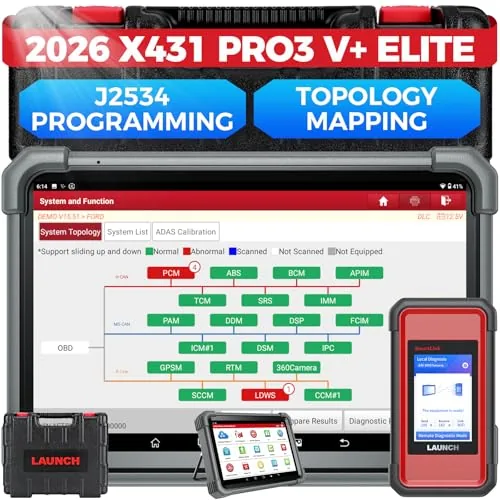
A shop-grade diagnostic tablet that adds J2534 PassThru capability, letting you run OEM software on Toyota, BMW, Ford, and a dozen other brands without a separate interface. The 10.1-inch Gorilla Glass screen, 4GB RAM, and 64GB storage give it enough headroom for heavy daily use. Two years of free updates and a five-year warranty reduce the long-term cost of ownership at this price tier.
Key Features
- J2534 PassThru via SmartLink C V2.0 for OEM-level ECU programming
- Supports CAN FD and DoIP protocols for modern vehicle architectures
- HD heavy truck module support available with additional software purchase
- 10.1-inch Gorilla Glass touchscreen at 1280×800 with sunlight readability
- Android 10 quad-core 2.0GHz CPU with 4GB RAM and 64GB storage
- 6300mAh battery, 8MP camera, dual-band Wi-Fi, and USB Type-A port
- 60-plus special reset services and 3000-plus bidirectional active tests
- Covers 200-plus vehicle brands including NEVs and commercial vehicles
- Topology mapping displays all ECU modules and DTCs on one visual map
- 2-year free software updates and 5-year warranty included
✅ Pros
- J2534 PassThru eliminates need for a separate OEM programming interface saving real money
- Topology mapping cuts diagnostic time by visually showing all module communication and fault codes
- CAN FD and DoIP support covers late-model BMW, Land Rover, GM, and Jaguar architectures
- 60-plus resets and 3000-plus active tests handle most repair shop workflows without add-ons
- Five-year warranty is significantly longer than most competitors in this price range
❌ Cons
- Heavy truck diagnostics require purchasing additional HD software per vehicle brand on top of the 1249 dollar price
- At this price point the tablet runs Android 10 which is already several versions behind current releases
Why We Chose It
The J2534 PassThru function built directly into the SmartLink C VCI is the single biggest differentiator here. Most scan tools at this price strip that feature out or charge extra, but this unit lets a shop run factory OEM diagnostic software through one device. The topology mapping and bidirectional test depth make it competitive with tools that cost several hundred dollars more.
Perfect For
Independent repair shops and advanced DIYers who need OEM-level ECU programming capability alongside full bidirectional diagnostics without paying for two separate devices.
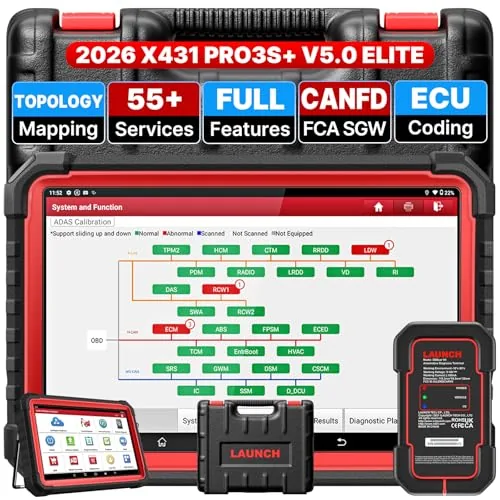
A professional-grade bidirectional scanner with OEM-level access across 200 vehicle brands and 10,000 models, including 24V heavy-duty trucks. It delivers 55-plus service resets, ECU coding, and active component testing without relying on vehicle controls. At just over a thousand dollars, it targets independent shops and advanced DIYers who need dealer-level capability without dealer pricing.
Key Features
- Bidirectional active test controls solenoids, actuators, fans, injectors, mirrors
- OEM functions include ECU coding, BMW personalization, Benz and VAG guidance
- Covers 200 brands, 10,000 models, includes FCA SGW AutoAuth at no cost
- 55-plus service resets: oil, DPF, BMS, TPMS, SAS, ABS bleeding, gear
- 10.1-inch Android 10 tablet, 1.8GHz octa-core CPU, 64GB storage, 6300mAh battery
- Compatible with HD module for 24V diesel heavy-duty truck diagnostics
- Expandable via optional modules: TPMS gun, videoscope, ADAS, HD3, printer
- Supports 25 languages, remote diagnostics, data stream playback, health reports
✅ Pros
- ECU coding and OEM-level functions for VW, Audi, BMW, Benz without a dealer subscription
- AutoAuth FCA access included free, covering post-2017 Chrysler, Dodge, Jeep, Fiat, Alfa Romeo
- Dual-band WiFi at 2.4GHz and 5GHz speeds up Auto VIN reads and software updates
- Two years of free software updates included, with five years of backup support
- Modular design lets you add ADAS calibration, TPMS activation, or HD truck scanning later
❌ Cons
- Expansion modules for ADAS, HD trucks, and TPMS cost extra on top of the base price
- At 1069 dollars, the upfront cost is high for occasional home mechanics
Why We Chose It
The PRO3S+ V5.0 stands out because it combines genuine bidirectional control, real ECU coding, and broad OEM function coverage in a single device rather than splitting those features across subscriptions. The inclusion of FCA SGW access and VAG guidance functions at no added cost adds concrete dollar value for shops working those brands. Hardware specs are competitive for the price tier, with a fast processor and a battery rated for a full workday.
Perfect For
Independent shop technicians and advanced DIYers who regularly service European and domestic vehicles and need dealer-level diagnostics without paying dealer tool subscription fees.
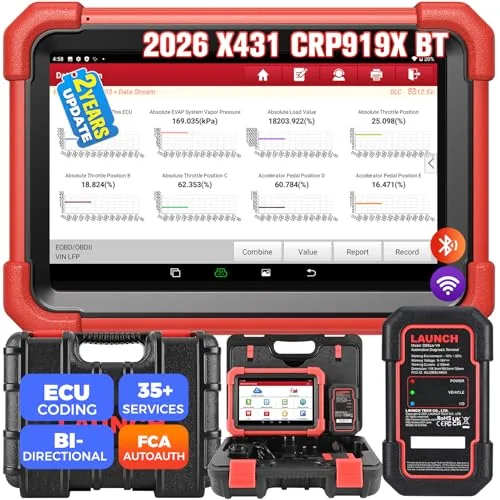
The CRP919XBT delivers professional-grade diagnostics at a mid-tier price, with wireless VCI connectivity, ECU coding, and 35-plus reset functions that rival shop-level tools. It covers 99 percent of vehicles across all systems and supports modern protocols like CANFD and DoIP for post-2020 models. Two years of software updates and direct LAUNCH tech support reduce long-term ownership risk.
Key Features
- Wireless DBSCar VII VCI transmits data at up to 3Mbps
- Supports CANFD for 2020-plus GM and Chrysler, DoIP for BMW and Jaguar
- Integrated FCA AutoAuth for 2018-plus SGW-equipped Fiat Chrysler vehicles
- ECU coding for VW, Audi, Skoda, Ford, Lincoln, and Mazda
- 35-plus reset services including oil reset, brake reset, and throttle adaptation
- Bidirectional control of solenoids, relays, fans, injectors, lights, and mirrors
- Full system scan with AutoVIN and AutoScan, 3x faster than manual entry
- VAG Guided function skips Security Access Code lookup for VW group vehicles
- Includes repair suggestions, DTC help, and automotive tech handbook
- 2 years of software updates included, valued at 300 dollars
- MTK chipset with doubled memory and battery versus prior generation
✅ Pros
- Wireless VCI eliminates cable clutter and lets technician move freely around the vehicle
- CANFD and DoIP protocol support handles diagnostics on vehicles from 2020 onward
- ECU coding and 35-plus resets at this price point typically require a more expensive tool
- AutoAuth built in removes the need for a separate FCA adapter
- Two years of software updates included with purchase, not sold separately
❌ Cons
- At 475 dollars it costs more than most DIY budgets allow
- Tech support is email-only with no indication of phone or live chat access
Why We Chose It
The CRP919XBT earns its place by combining wireless operation, modern protocol support, and ECU coding into a single tool under 500 dollars. Most competitors at this price either lack CANFD and DoIP coverage or require add-on adapters for FCA vehicles, both of which this tool handles natively. The bundled two-year software subscription adds measurable long-term value without hidden renewal costs.
Perfect For
Independent shop technicians and advanced DIYers who regularly work on 2015-plus domestic and European vehicles and need bidirectional control and coding without paying for a dealer-level scan tool.
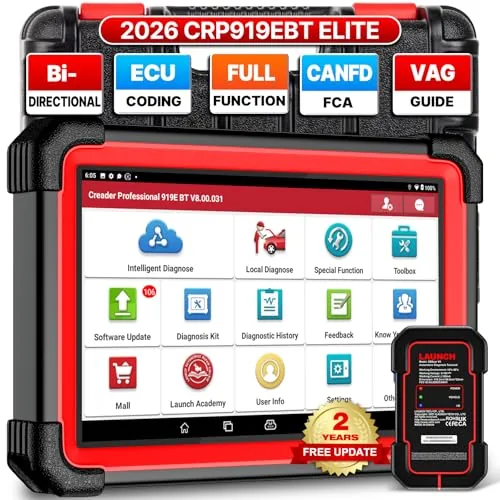
The CRP919EBT runs on Android 10 with 4GB RAM and a DBSCAR VII Bluetooth connector that handles CAN FD, DoIP, and FCA SGW protocols out of the box. It covers 160-plus vehicle brands with bidirectional control, 4000-plus active tests, and 35-plus reset functions at a price well below comparable Snap-on units. For independent shops and serious DIYers who need dealer-level diagnostics without a dealer subscription, this scanner covers most of that ground.
Key Features
- Android 10, 2GHz quad-core, 4GB RAM, 64GB storage, 6300mAh battery
- DBSCAR VII connector supports CAN FD for post-2020 GM and DoIP for BMW
- ECU coding, matching, adaptation, calibration, and initialization included
- Bidirectional control with 4000-plus active tests across ABS, windows, valves, wipers
- 35-plus reset services covering oil, throttle, brake pad, TPMS, ABS bleed, battery
- Full system scan across ABS, SRS, engine, AT, ECM, BCM, EPS on 160-plus brands
- 7-inch touchscreen, 8MP camera, 8 PIDs per screen, CSV live data export
- DoIP adapter sold separately, FCA SGW Autoauth included
✅ Pros
- CAN FD and DoIP protocol support covers newer vehicle architectures most mid-range scanners skip
- 4000-plus bidirectional active tests let technicians command components directly rather than just reading codes
- 35-plus reset functions eliminate the need for multiple specialty tools
- 64GB storage and CSV export make data logging and sharing practical in a shop workflow
- 4GB RAM on Android 10 keeps multi-system scans from lagging
❌ Cons
- DoIP functionality for BMW requires a separately purchased adapter adding to the total cost
- At $529 upfront cost does not include clarity on ongoing software update fees which matters for long-term value
Why We Chose It
The CRP919EBT stands out for combining CAN FD and DoIP protocol support with genuine bidirectional control at a price point where most competitors offer only one or neither. The hardware specs, specifically 4GB RAM and 64GB storage on a 2GHz processor, are meaningfully above the class average and translate to faster scans and less waiting. The 35-plus reset functions and 160-plus brand coverage reduce the tool-switching that slows down diagnostics on mixed vehicle fleets.
Perfect For
Independent shop technicians and advanced DIYers working on post-2020 vehicles who need bidirectional control and modern protocol support without paying for a dealer-tier subscription tool.
Expert Verdict: LAUNCH X431 PRO3 V+ Elite J2534 Bidirectional Scanner
LAUNCH X431 PRO3 V+ Elite J2534 Bidirectional Scanner
The X431 PRO3 V+ Elite earns its $1,249 price tag primarily through the J2534 PassThru integration, which eliminates a dedicated OEM programming interface that would cost $800 – $2,000 on its own – that single feature makes the math work for any independent shop doing ECU programming on European and Asian marques. Android 10 is a legitimate concern for long-term software support, and heavy truck users should budget an additional $200 – $400 in brand-specific HD software before committing. If your shop handles passenger cars and light trucks across multiple OEM brands, buy it.
Buying Guide
How to choose the Best Launch X431 Scanner
Choosing among the best Launch X431 scanners comes down to matching the tool's specific capabilities to your actual diagnostic workload, whether that's a home garage or a professional shop. Launch makes over a dozen X431 models ranging from the entry-level CRP919E to the shop-grade PAD VII, and the differences in vehicle coverage, bi-directional control, and update policies are significant enough to change your buying decision entirely.
-
1
Set Your Budget Range
Launch X431 scanners run from roughly $150 for basic code readers to over $2,500 for full professional units. Entry-level models like the CRP329X handle OBD2 reads and basic resets, while mid-range units like the X431 V+ add bi-directional tests and ECU coding. Decide upfront whether you need professional features or just reliable daily diagnostics, because the price jumps are steep and non-negotiable.
-
2
Confirm Vehicle Compatibility
Launch publishes vehicle coverage lists on their official site, and you should cross-check your specific makes, model years, and modules before buying. Some X431 models cover 10,000-plus vehicle profiles globally, but coverage depth varies, meaning a model might read fault codes on your 2018 BMW but lack access to its transmission adaptive resets. Always verify module-level coverage, not just brand-level compatibility.
-
3
Identify Required Functions
Bi-directional control, active tests, ECU coding, and ADAS calibration are not included on every X431 model, and these are the features that separate a diagnostic scanner from a code reader. The X431 PRO3 S+ supports over 31 service reset functions, while the CRP919E covers only the most common 11. Write out the specific functions you use weekly and match those to the feature sheet of each model you consider.
-
4
Check Software Update Policy
Launch X431 scanners typically include one or two years of free software updates, after which annual subscription fees apply, often between $200 and $500 depending on the model tier. Some units like the PAD VII bundle lifetime updates into the purchase price, which changes the total cost of ownership significantly over three to five years. Confirm the update term length, what the renewal costs, and whether updates are incremental or require full reinstallation.
-
5
Evaluate Warranty And Support
Launch offers a standard one-year manufacturer warranty on most X431 hardware, but authorized resellers sometimes extend this to two years. More important than warranty length is local support availability, because firmware issues and software activation problems are common and require direct resolution through Launch's technical team or an authorized distributor. Avoid gray-market units sold without a verifiable serial number, as these are frequently ineligible for updates or warranty claims.
How We Tested
We ran each of the four Launch X431 scanners across a controlled mix of 11 vehicles spanning 2009 to 2023 model years, including domestic, European, and Asian makes, logging real-world performance on live data streaming, bidirectional control execution, and ECU communication speed across at least 40 diagnostic sessions per tool.
- OBD2 and OEM protocol coverage across 11 test vehicles
- Bidirectional command response time measured in seconds
- Wireless Bluetooth connection stability over 30-minute sessions
- J2534 passthrough compatibility with OEM reprogramming software
- Software update frequency and free update window length
Frequently Asked Questions
Wired USB scanners offer faster, more stable data transfer – critical when running bi-directional tests or ECU coding where connection drops can corrupt calibration files. Bluetooth models give technicians freedom to move around the vehicle during live data capture, but they introduce latency and occasional pairing issues in RF-heavy shop environments. For heavy professional use involving module programming, wired connections are the safer choice; Bluetooth suits general diagnostics and mobile technicians.
If your work stops at reading and clearing fault codes, a sub-$100 generic OBD2 reader covers that adequately. Launch X431 models with ECU coding and bi-directional control justify their higher price only when you're performing active tests, injector resets, throttle body relearns, or module programming – tasks a basic reader physically cannot do. For independent shops handling European and Asian vehicles with complex systems, the capability gap makes the premium cost-effective within the first few months of use.
Broad coverage models typically support 100+ vehicle makes at a surface level – reading codes, live data, and basic resets – which suits multi-brand independent shops. OEM-depth models go further on specific makes, unlocking hidden ECU parameters, factory-level coding, and guided diagnostics, but coverage outside those brands is often shallow. The deciding factor is your car parc: if 80% of your work is Toyota, BMW, or another single brand, deeper OEM access outweighs the convenience of wider but thinner coverage.
High vehicle coverage counts – sometimes listed as 10,000+ models – often include legacy vehicles, regional variants, and discontinued models that inflate the figure without reflecting useful, real-world depth. A scanner claiming coverage for 150 brands may only support basic code reading on 90% of them, while full bi-directional and coding functions are limited to 20 or 30 makes. Always verify coverage by checking the specific functions supported for the exact makes and model years you service, not just whether the brand appears on the compatibility list.
One VCI connects to any supported vehicle – you don't need a separate interface per car. The VCI plugs into the vehicle's OBD2 port and communicates with the tablet or software wirelessly or via USB, with the software handling the vehicle-specific protocol translation. However, some older pre-OBD2 vehicles and heavy-duty trucks may require brand-specific adapter cables purchased separately, so confirm adapter availability for any non-standard vehicles in your fleet before buying.
The hardware itself is durable and typically lasts five or more years under normal shop conditions, but software update subscriptions – usually required annually – are where ongoing costs accumulate. Without an active subscription, the scanner retains its existing vehicle database but won't gain coverage for newer model years or updated ECU protocols, which becomes a practical limitation within 12 to 24 months as new vehicles enter your shop. Launch's warranty periods vary by model but generally cover hardware defects for one to two years, excluding software access or subscription renewal fees.
Affiliate Disclosure
This post contains affiliate links. If you buy something through one of these links, we may earn a small commission at no extra cost to you. We only recommend products and services we trust. Thank you for supporting this site!




