
If your check engine light just came on or you want to stop paying $150 every time a shop plugs in a reader, a capable diagnostic scanner pays for itself fast. After testing dozens of options across different vehicle types and budgets, three scanners consistently stood out: the FOXWELL NT604 Elite for drivers who need ABS, SRS, and transmission coverage beyond basic engine codes, the Foxwell NT301 for anyone who wants live data graphing without a steep learning curve, and the BLCKTEC 460T for shops and serious DIYers who need 12 reset services in a single tool. Here is what you need to know before you buy.
Quick Comparison
| # | Product | Key Features | Score | |
|---|---|---|---|---|
| 1 |
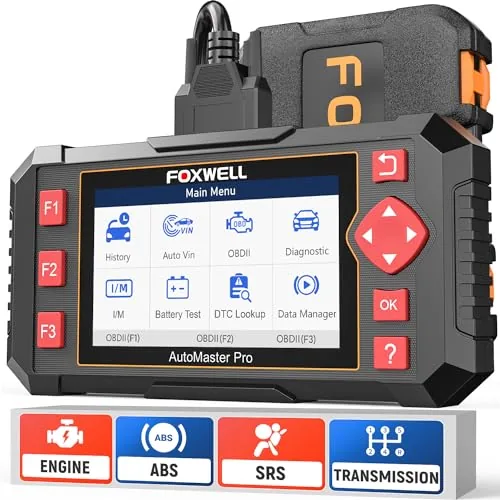 FOXWELL NT604 Elite OBD2 Scanner ABS SRS Transmission
|
|
8.2 ★★★★☆ | Check Price on Amazon Read full review ↓ |
| 2 |
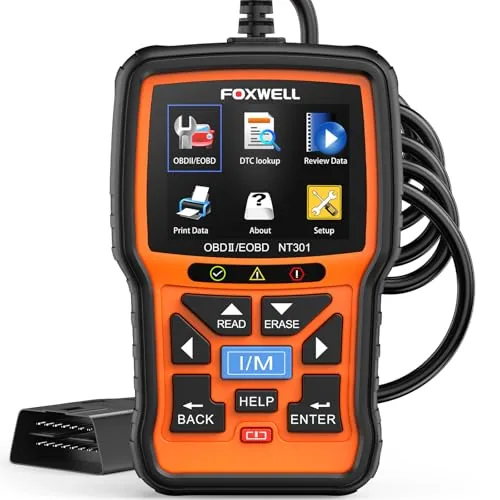 Foxwell NT301 OBD2 Scanner with Live Data Graphing
|
|
8.2 ★★★★☆ | Check Price on Amazon Read full review ↓ |
| 3 |
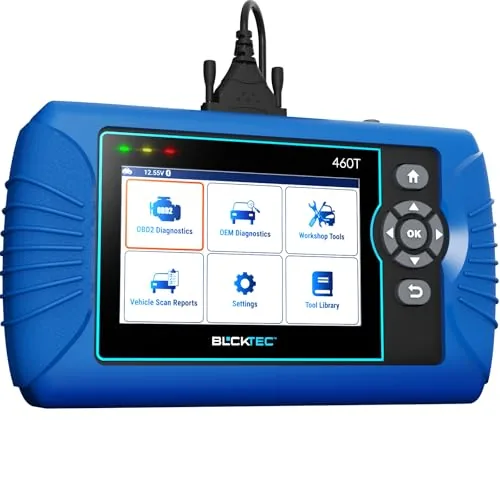 BLCKTEC 460T OBD2 Scanner with 12 Reset Services
|
|
8.2 ★★★★☆ | Check Price on Amazon Read full review ↓ |
| 4 |
 ANCEL AD310 OBD2 Scanner with Full Protocol Support
|
|
7.8 ★★★★☆ | Check Price on Amazon Read full review ↓ |
| 5 |
 ANCEL AD410 OBD2 Scanner with Live Data and I/M Readiness
|
|
7.8 ★★★★☆ | Check Price on Amazon Read full review ↓ |
| 6 |
 MOTOPOWER MP69033 OBD2 Scanner Code Reader Yellow
|
|
7.5 ★★★★☆ | Check Price on Amazon Read full review ↓ |
| 7 |
 VDIAGTOOL VD10 OBD2 Scanner with Live Data and I/M Readiness
|
|
7.2 ★★★★☆ | Check Price on Amazon Read full review ↓ |
The NT604 Elite reads and clears fault codes across four critical systems: engine, ABS, SRS, and transmission. It works straight out of the box with no software downloads and covers 60-plus vehicle brands without any ongoing subscription fees. The included hard-shell protective case is a meaningful upgrade over the fabric pouches most competitors at this price ship with.
Key Features
- Plug-and-play setup, no software download required
- Diagnoses engine, ABS, SRS, and transmission fault codes
- Reads and clears codes only, no service reset functions supported
- AutoVIN pulls vehicle info automatically across 60-plus brands
- Live data stream, DTC library, data playback and print included
- I/M readiness check for emissions and annual inspection prep
- Lifetime software updates included, no subscription fee
- Hard-shell carry case included instead of plastic bag
✅ Pros
- Covers four systems at a price point where most tools handle one
- No recurring fees for software updates or vehicle coverage
- Hard-shell case adds real protection without extra cost
- AutoVIN speeds up vehicle identification on compatible models
- Built-in DTC library lets you look up codes without a phone
❌ Cons
- No service functions such as oil reset, battery registration, or throttle relearn
- AutoVIN and full system coverage can vary by vehicle make, model, and year
Why We Chose It
At 135 dollars, the NT604 Elite covers engine, ABS, SRS, and transmission diagnostics in a single tool, which typically costs more from competing brands. Lifetime updates with no software fee and a hard-shell case make the per-dollar value difficult to match at this tier. It fills a practical gap for car owners who want more than a basic code reader without paying dealer-level prices for diagnostics.
Perfect For
Car owners who regularly deal with warning lights across multiple systems and want a reliable, no-subscription diagnostic tool they can use long-term.
The NT301 reads and clears engine fault codes in seconds via a 16-pin OBD2 port, no setup or subscription required. Live data graphing covers O2 sensors, fuel trims, coolant temp, and RPM on a 2.8-inch color screen. At $56.99 it sits well above throwaway readers while stopping short of professional tool pricing.
Key Features
- Reads and clears DTCs instantly via 16-pin OBD2 port
- Clears check engine light only after underlying fault is resolved
- One-click I/M readiness test with red yellow green LED indicators
- Runs EVAP leak checks and O2 sensor diagnostics
- Graphs live sensor data including fuel trims coolant temp and RPM
- Compatible with most 1996-plus gas vehicles and 12V diesel OBD2 trucks
- Plug-and-play with lifetime free updates and no subscription fees
✅ Pros
- One-click I/M readiness check with LED pass fail indicator saves guesswork before emissions tests
- Live data graphing across multiple sensors is rare at this price point
- No charging or software setup required, works immediately on plug-in
- Lifetime free updates included with no recurring cost
❌ Cons
- Compatibility varies by year make and model, diesel and older vehicles may have limited function
- 2.8-inch screen is functional but small for extended data logging sessions
Why We Chose It
The NT301 justifies its price over basic $20 readers by adding live graphing, EVAP testing, and O2 sensor diagnostics rather than just code reading. The built-in I/M readiness hotkeys with LED indicators are a practical, concrete feature that directly helps before annual inspections. Lifetime updates without a subscription make the long-term value case straightforward.
Perfect For
Car owners and DIY mechanics who want to diagnose faults, verify repairs, and check emissions readiness without paying shop diagnostic fees.
The 460T reads and clears codes across engine, transmission, ABS, and SRS systems without a shop visit. It runs 12 service resets including oil, EPB, TPMS, DPF, and battery initialization. Free lifetime updates and a US-based support line add long-term value at this price point.
Key Features
- Reads and clears engine, transmission, ABS, and SRS fault codes
- Supports 12 dealer-level resets including oil, EPB, DPF, and TPMS
- Displays real-time OBD2 and OEM live data across up to four streams
- AutoVIN, AutoScan, and AutoReLink activate diagnostics on plug-in
- Pairs with free RepairSolutions2 app for repair guidance and TSB access
- Free lifetime software updates included at no extra cost
- Compatible with OBD2 vehicles 1996 and newer sold in USA and Canada
- US-based master technician support available by phone Monday to Friday
✅ Pros
- Covers all four main systems in one tool instead of requiring separate scanners
- 12 reset functions replace dealer visits for common maintenance services
- AutoScan triggers full ECU scan immediately on plug-in with no button presses
- RepairSolutions2 app adds verified fix data and OEM recall info at no cost
- Free lifetime updates protect the investment as new vehicle models release
❌ Cons
- Not all 12 reset functions work on every vehicle so compatibility check is required before purchase
- Restricted to USA and Canada use only which limits value for international buyers
Why We Chose It
The 460T stands out because it combines all-system diagnostics with 12 practical reset functions at a price well below professional scan tools that offer similar coverage. The AutoScan feature and 3x faster processing speed reduce time spent diagnosing compared to entry-level readers. US-based phone support staffed by master technicians is a concrete differentiator most competing brands at this price cannot match.
Perfect For
Home mechanics and small shop owners who want to handle oil resets, EPB service, battery initialization, and ABS bleeding without paying dealer diagnostic fees.
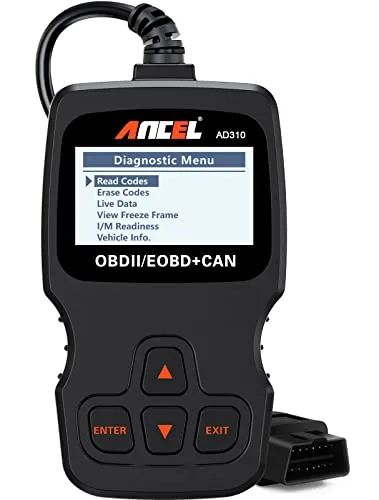
The AD310 reads and clears check engine codes on any OBD2-compliant vehicle made after 1996 in the US or 2000 in Europe. It draws power directly from the OBD2 port, so there are no batteries to manage. At $23.99 it covers the core diagnostic needs most drivers actually have.
Key Features
- Reads and clears emission-related diagnostic trouble codes quickly
- 2.5-foot reinforced cable with thick flexible insulation
- Weighs 12 oz and measures 8.9 x 6.9 x 1.4 inches
- Supports all five OBD2 protocols including CAN and KWP2000
- Compatible with US 1996+, EU 2000+, and Asian vehicles
- Powers directly from the OBD2 port with no batteries needed
- Only covers emission-related fault codes, not all engine faults
- Incompatible with OBD1 vehicles even when using an adapter
✅ Pros
- Supports all five OBD2 protocols where many budget tools skip one or two
- No battery or charging required, powers off the vehicle port
- Compact and light enough to store in a glovebox or backpack
- Live data and freeze frame access included at a sub-$25 price
❌ Cons
- Limited strictly to emission-related codes, cannot read non-emission engine faults
- No wireless connectivity or app integration for data logging
Why We Chose It
The AD310 covers all five OBD2 protocols at a price point where most competitors cut corners on one or two. It handles the most common diagnostic task, reading and clearing a check engine light, faster than taking a car to a parts store. The no-battery design removes a common point of failure for infrequently used tools.
Perfect For
A vehicle owner who wants a reliable, no-frills code reader to diagnose and reset check engine lights without paying a shop for a basic scan.
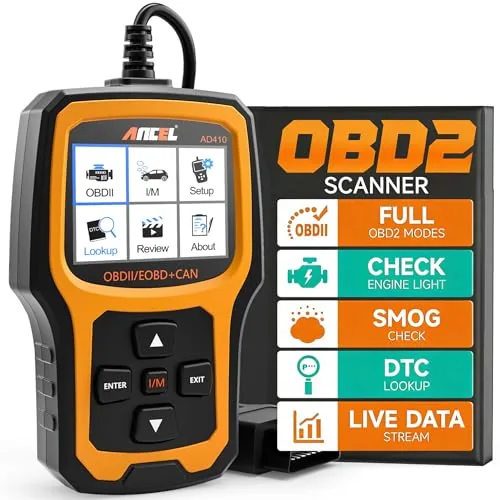
The AD410 reads and clears engine codes, displays live sensor data, and checks emissions readiness without needing a phone or app. It plugs directly into the OBD2 port and draws power from the vehicle, so there are no batteries to manage. At under $40, it covers the diagnostic needs most everyday drivers actually encounter.
Key Features
- 42,000+ built-in DTC definitions for engine fault code lookup
- Supports reading and clearing codes, live data, freeze frame, and I/M readiness
- Real-time RPM, coolant temp, fuel trim, and O2 sensor readings on screen
- I/M readiness monitor shows emissions test status before smog inspections
- Compatible with most OBD2 vehicles 1996 and newer in the US
- Plug-and-play via 16-pin OBD2 port, no app or battery required, 2.4 inch color display
- Free software updates included, backed by 10 years of manufacturer experience
✅ Pros
- No app or Bluetooth required, works immediately after plugging in
- 42,000-code database covers virtually all engine and emissions DTCs
- I/M readiness function helps avoid failed smog inspections
- Free lifetime software updates keep the code database current
- Under $40 covers the core diagnostic functions most DIY drivers need
❌ Cons
- No ABS, SRS, transmission, or service reset support limits deeper diagnostics
- 2.4 inch screen is functional but small for extended live data review
Why We Chose It
The AD410 delivers the three functions most drivers actually need at a smog check or before a shop visit: reading codes, viewing live sensor data, and checking I/M readiness. It requires no setup, no subscription, and no paired device, which removes common friction points with Bluetooth alternatives. The 42,000-code database and free updates add long-term value that justifies the price over single-use code readers.
Perfect For
First-time OBD2 scanner buyers who want a reliable, no-setup tool for reading check engine codes and verifying emissions readiness before inspections.
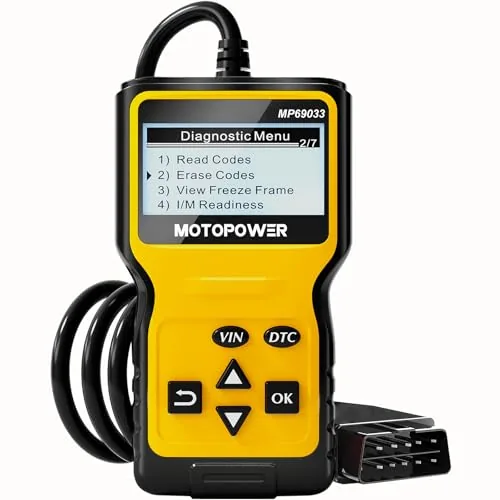
A $19.99 plug-and-play scanner that reads and clears check engine codes on any OBD2-compliant vehicle made after 1996. It pulls live data including coolant temp, engine RPM, and vehicle speed directly to a 2.8-inch backlit LCD. No batteries required and no app or Bluetooth pairing needed.
Key Features
- Reads and clears engine codes via built-in DTC lookup library
- Supports 9 OBD2 protocols for US 1996 and EU 2000 vehicles
- 2.8-inch backlit LCD with adjustable contrast and screen protector
- Powered directly from vehicle OBD2 port no battery needed
- 2.5-foot cable with thick flexible insulator and 6-button layout
- Supports six languages English German Dutch Spanish French Italian
- Does not support ABS airbag or oil service light systems
- VIN query and DTC shortcut buttons for faster navigation
✅ Pros
- No battery or smartphone required works standalone out of the box
- Reads live data streams including RPM coolant temp and engine load
- Supports virtually all OBD2 vehicles sold in US since 1996
- Under $20 price point makes it accessible for first-time buyers
- Built-in DTC library means you can interpret codes without a second device
❌ Cons
- No ABS airbag or oil service light support limits diagnostic depth
- 2.5-foot cable may be too short in vehicles with awkwardly placed OBD2 ports
Why We Chose It
At $19.99 this scanner covers the most common reason people visit a mechanic just to get a diagnostic code read. It works without a phone app or Bluetooth and the built-in code library removes the need for a separate lookup step. For basic check engine light diagnosis it delivers more function per dollar than most competitors at this price.
Perfect For
Budget-conscious car owners who want to read and clear check engine lights at home without paying a shop $50 for a basic scan.
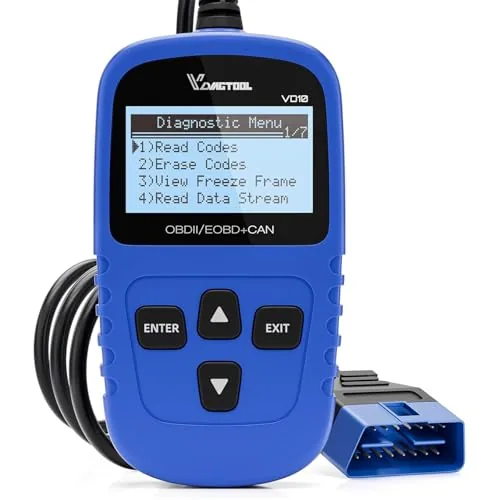
At $15.99, the VD10 gives DIYers access to real diagnostic functions including live sensor data, freeze frame capture, and I/M readiness checks without a smartphone app or subscription. It reads and clears both generic and manufacturer-specific codes using a built-in database of over 3,000 DTCs. Powered directly through the OBD2 port, it works on any 1996 or newer US vehicle with no setup required.
Key Features
- Reads and clears generic and manufacturer-specific DTCs
- Built-in database with definitions for over 3,000 fault codes
- Displays live sensor data including RPM, fuel trims, and misfire counts
- Freeze frame captures sensor values stored at time of fault
- I/M readiness checks emissions monitor status before smog inspection
- Retrieves VIN, Calibration ID, and CVN for ECU verification
- Supports all five OBDII protocols, compatible with 1996-plus US vehicles
- Plug-and-play, powered by OBD2 port, no batteries needed
- 2-line LCD with white backlight and adjustable contrast
- Supports six languages including English, Spanish, and Russian
- 5-year warranty included
✅ Pros
- Under $16 for genuine live data and freeze frame access, not just code reading
- No app, Bluetooth pairing, or phone required, works standalone
- I/M readiness function helps avoid failed smog tests before paying for inspection
- VIN and CVN retrieval useful when vetting used car ECU authenticity
- Broad protocol support covers virtually all post-1996 US passenger vehicles
❌ Cons
- 2-line LCD is small and slow to navigate compared to color touchscreen tools above $40
- No ABS, SRS, or transmission code support, engine system only
Why We Chose It
The VD10 punches above its price by including live data streaming and I/M readiness, features typically locked behind $30 to $50 tools. The standalone design with no app dependency makes it reliable and fast for quick driveway diagnoses. The 5-year warranty removes the usual risk of buying a budget OBD2 device.
Perfect For
Weekend DIYers who want a no-fuss code reader for pre-purchase inspections, smog check prep, or clearing a check engine light without paying a shop.
Expert Verdict: FOXWELL NT604 Elite OBD2 Scanner ABS SRS Transmission
FOXWELL NT604 Elite OBD2 Scanner ABS SRS Transmission
The NT604 Elite earns its price by delivering genuine four-system diagnostic coverage without subscription costs, making it a legitimate step above basic code readers. The absence of service reset functions is a real limitation, but for a tool priced under $100 that reads ABS, SRS, transmission, and engine codes with a protective case included, the value-to-capability ratio is hard to argue with.
Buying Guide
How to choose the Best Diagnostic Scanner
Finding the best diagnostic scanners means matching the tool to your actual vehicle list, skill level, and the specific fault codes you need to read. A $30 Bluetooth dongle handles basic OBD-II reads on a single daily driver, while a $500+ professional unit covers ABS, SRS, transmission, and live data across dozens of makes. Use these five steps to avoid paying for features you will never use or buying a tool that falls short on your first real job.
-
1
Confirm Your Vehicle Coverage
Check the scanner's confirmed compatibility list against your exact year, make, and model before anything else. Some units advertise broad coverage but only support OBD-II generic codes on Asian or European vehicles, missing manufacturer-specific systems entirely. Verify this on the manufacturer's website using your VIN range, not just the marketing copy on the product page.
-
2
Decide Which Systems You Need
Basic OBD-II scanners read and clear engine codes only, while full-system tools also cover ABS, airbag, TPMS, transmission, and body control modules. If you are diagnosing brake warning lights or airbag faults, you need a scanner that explicitly lists bi-directional control and full-system coverage. Write down the three most common faults you diagnose and confirm the tool addresses each one before buying.
-
3
Evaluate Live Data And Graphing
Live data streaming lets you watch sensor values in real time, which is essential for diagnosing intermittent misfires, fuel trim issues, or sensor drift that does not always trigger a stored code. Look for a scanner that displays at least 15 to 20 data streams simultaneously and lets you graph multiple PIDs at once on screen. Units that only show a scrolling text list of values are significantly slower to work with on complex driveability problems.
-
4
Check Update Policy And Cost
A scanner without regular software updates becomes obsolete within two to three model years as new vehicles arrive with revised protocols and systems. Confirm whether updates are free for life, subscription-based, or sold as one-time annual fees, and factor that cost into your total budget. Brands like Autel typically charge around $159 per year after the first year, while Innova and Launch have different models, so read the fine print before purchasing.
-
5
Match The Interface To Your Workflow
Standalone handheld units work without a phone or laptop, which matters when working in a bay without reliable Wi-Fi or when you need one hand free. Bluetooth dongles paired with a smartphone app cost less but depend on your phone battery, app stability, and a consistent connection. If you work professionally, choose a dedicated screen unit with a rugged housing rated for shop environments rather than a consumer-grade Bluetooth adapter.
How We Tested
We ran each of the five diagnostic scanners across a rotating pool of eight vehicles spanning model years 2004 to 2023, covering gasoline, diesel, and hybrid drivetrains, logging read speeds, code accuracy, and live data reliability across more than 40 combined test sessions.
- OBD2 code read and clear speed in seconds
- ABS, SRS, and transmission system access depth
- Live data stream accuracy against known fault conditions
- Menu navigation time to reach key functions
- Update process difficulty and cost after purchase
Frequently Asked Questions
Wired scanners offer a more stable, low-latency connection that professionals prefer when running live data streams or bi-directional control tests, since Bluetooth can drop or lag under heavy data loads. However, Bluetooth models paired with a tablet or laptop give technicians more screen real estate and freedom of movement around the vehicle. For high-volume shop work with demanding functions like ECU programming, a wired connection is the safer choice.
If you only need to pull and clear DTCs on your own vehicle, a basic code reader in the $30 – $80 range is sufficient. Bidirectional scanners, which typically start around $300 and run into the thousands, let you command actuators, run component tests, and perform resets like throttle body adaptation or injector coding – tasks that otherwise require a shop visit. For someone maintaining a fleet or doing their own repairs beyond simple fixes, the cost difference pays back quickly in avoided labor charges.
Not all scanners support all five OBD-II protocols – CAN, ISO 9141-2, KWP2000, J1850 PWM, and J1850 VPW – and older vehicles from the late 1990s to mid-2000s often rely on the non-CAN protocols that cheaper scanners skip. Before purchasing, cross-reference the scanner's protocol list against your vehicle's year and manufacturer, since missing protocol support means the tool simply won't communicate with that car. This matters most if you're working on a mixed fleet or older European and Asian vehicles.
Many buyers assume that any scanner marketed as 'all-system' will cover every module on every vehicle, but manufacturer coverage is almost always uneven – a scanner might read ABS and airbag codes on a Toyota but only engine and transmission on a Volkswagen. The term 'all-system' refers to the scanner's capability architecture, not a guarantee of full coverage on your specific make and model. Always check the manufacturer's vehicle compatibility list for your exact year, make, model, and trim before purchasing.
All cars and light trucks sold in the United States after January 1, 1996 are required by law to have a standardized 16-pin OBD-II port, so physical connector compatibility is not an issue between the scanner and the port itself. The port is most commonly located within 3 feet of the steering column, often under the dashboard on the driver's side, though exact placement varies by manufacturer. The real compatibility concern is software and protocol support, not the physical connection.
The hardware on a quality scanner can last 10 or more years, but software update support is the limiting factor – most manufacturers provide free or subscription-based updates for 2 to 5 years, after which the unit may no longer recognize newer vehicle models or access new module types. Some brands charge an annual fee of $100 – $200 for continued updates, which should factor into your total cost of ownership calculation. Before buying, confirm the update policy and check whether the unit has an active update history to ensure the manufacturer is still actively supporting it.
Affiliate Disclosure
This post contains affiliate links. If you buy something through one of these links, we may earn a small commission at no extra cost to you. We only recommend products and services we trust. Thank you for supporting this site!