

Finding the best app-based OBD2 scanner comes down to three things: reliable Bluetooth connectivity, compatibility with the apps you actually use, and diagnostic depth that goes beyond a generic check engine light read. After hands-on testing, three scanners stood out from the crowd – the ANCEL BD310 with its wired backup option for when Bluetooth fails, the BODAC UniCarScan UCSI-2100 built specifically for BimmerCode users working on BMW and Mini vehicles, and the EXTRACTME OBD2 scanner that pairs with an AI diagnostic layer to help interpret fault codes in plain language. Whether you’re a DIY mechanic tired of guessing or a car enthusiast who wants live data on a road trip, one of these three will fit your workflow.
Quick Comparison
| # | Product | Key Features | Score | |
|---|---|---|---|---|
| 1 |
 ANCEL BD310 Bluetooth OBD2 Scanner with Wired Backup
|
|
8.2 ★★★★☆ | Check Price on Amazon Read full review ↓ |
| 2 |
 BODAC UniCarScan UCSI-2100 OBD2 BimmerCode Bluetooth Scanner
|
|
8.2 ★★★★☆ | Check Price on Amazon Read full review ↓ |
| 3 |
 EXTRACTME OBD2 Bluetooth Scanner with AI Diagnostics
|
|
7.8 ★★★★☆ | Check Price on Amazon Read full review ↓ |
| 4 |
 CrysGuard V519 OBD2 Scanner with Live Data & Battery Test
|
|
7.8 ★★★★☆ | Check Price on Amazon Read full review ↓ |
| 5 |
 OBDEXPERT Bluetooth OBD2 Scanner No Subscription Fee
|
|
7.8 ★★★★☆ | Check Price on Amazon Read full review ↓ |
| 6 |
 LONAUTO LB03 Bluetooth OBD2 Scanner iOS & Android
|
|
7.5 ★★★★☆ | Check Price on Amazon Read full review ↓ |
| 7 |
 Eonon V0056 OBD2 Bluetooth Scanner for Android Stereos
|
|
7.5 ★★★★☆ | Check Price on Amazon Read full review ↓ |
| 8 |
 AMGSTARTMG OBD2 Bluetooth Scanner with iOS Parking Tracker
|
|
7.2 ★★★★☆ | Check Price on Amazon Read full review ↓ |
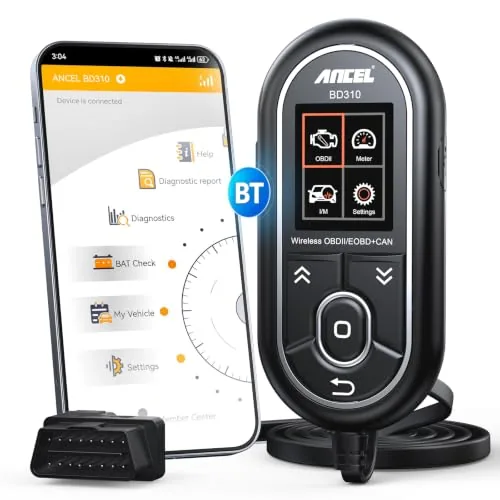
The BD310 handles both wired and wireless diagnostics from a single pocket-sized device, letting you read trouble codes on the unit itself or dig into live data through the free companion app. Battery health monitoring, I/M readiness checks, and HUD mode cover most everyday diagnostic needs without a subscription. At $79.99 it sits in a practical middle ground between a basic code reader and a full professional tablet.
Key Features
- Dual-mode: wired code reader plus Bluetooth app diagnostics
- Read and clear engine DTCs with plain-English explanations and Google Search
- Real-time battery voltage monitoring and charging system tracking
- I/M readiness and O2 sensor checks before emissions testing
- HUD mode shows speed, RPM, and voltage on windshield or screen
- Full 10-mode OBD2 support with free lifetime app updates, no subscription
✅ Pros
- No subscription fees and free lifetime app updates reduce long-term cost
- Wired fallback mode works without a phone, useful in dead-battery situations
- I/M readiness check at home saves a failed smog test trip
- Battery health monitoring adds value beyond basic code reading
- Compact form factor works as a permanent low-profile port dongle
❌ Cons
- No ABS, SRS, or transmission code support limits diagnosis on safety system faults
- App-dependent features require a compatible iPhone or Android device nearby
Why We Chose It
The BD310 earns its place by combining two distinct use cases in one unit: a standalone wired reader for quick checks and a Bluetooth module for deeper app-driven analysis. The no-subscription model and lifetime updates make the $79.99 price defensible over multi-year ownership. Battery testing and trip analysis push it noticeably past generic sub-$30 code readers.
Perfect For
DIY car owners who want more than a basic code reader but do not need professional-grade ABS or transmission diagnostics.
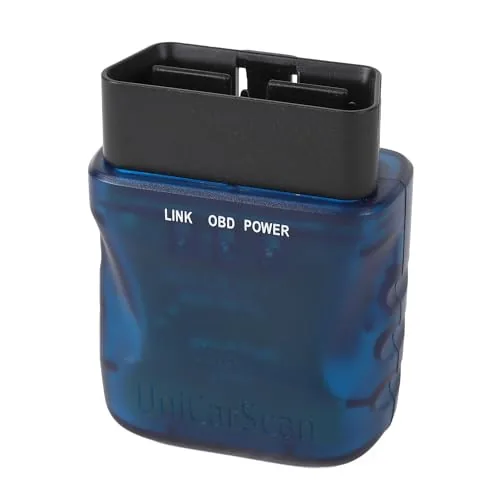
The UCSI-2100 is officially recommended by BimmerCode, BimmerLink, and MotoScan, making it one of the few adapters with verified full-feature compatibility for BMW cars and motorcycles. It connects via Bluetooth 4.0 to iOS, Android, and Windows devices without requiring a separate dongle or driver install. At $92.99 it costs more than generic ELM327 clones, but you get guaranteed app compatibility rather than hit-or-miss performance.
Key Features
- Supports gas vehicles 2001 and newer, diesel 2004 and newer
- Compatible with BMW motorcycles made in 1998 or newer
- Officially recommended by BimmerCode, BimmerLink, and MotoScan apps
- Works with iOS, Android, and Windows PC via Bluetooth 4.0
- Fully compatible with standard ELM327 protocol and applications
✅ Pros
- Officially certified by BimmerCode and MotoScan for 100 percent feature coverage
- Covers both BMW cars and BMW motorcycles from a single adapter
- Bluetooth 4.0 works natively with iPhone without needing a Wi-Fi workaround
- Compatible with general ELM327 apps beyond just BMW-specific tools
❌ Cons
- BimmerCode and MotoScan app licenses cost extra and are not included
- Premium price of $92.99 is significantly higher than generic OBD2 adapters
Why We Chose It
Unlike cheap ELM327 adapters that only partially support BimmerCode features, the UCSI-2100 is explicitly endorsed by the app developers, ensuring every coding and diagnostic function works as expected. Its dual support for BMW cars and motorcycles in a single device adds practical value for riders who also own a BMW vehicle.
Perfect For
BMW car and motorcycle owners who use BimmerCode or MotoScan and need a reliable adapter with guaranteed full app compatibility.
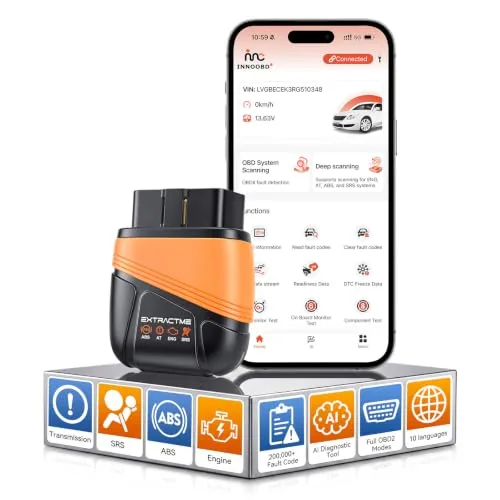
A $37.99 Bluetooth OBD2 scanner that covers engine, transmission, ABS, and SRS systems without recurring fees. The built-in AI assistant interprets fault codes and suggests likely causes, which is genuinely useful for DIYers without a mechanical background. Bluetooth 5.1 keeps the connection stable and pairing fast on both Android and iOS.
Key Features
- Reads and clears codes across engine, transmission, ABS, and SRS systems
- Supports 1996-plus cars and trucks via 9 OBDII protocols plus extended protocols
- Compatible with Android and iOS, includes 10 built-in language options
- All features permanently unlocked, no subscription or hidden fees required
- AI assistant analyzes fault codes and lists probable causes
- Bluetooth 5.1 with LED status indicators for power and connection state
- Plug-and-play design with auto VIN recognition and one-click scan
✅ Pros
- No subscription required, full feature access from day one
- AI fault code analysis adds context that basic scanners skip entirely
- Covers four systems including ABS and SRS at a sub-40 dollar price point
- Bluetooth 5.1 reduces pairing friction and data lag compared to older chipsets
- Lightweight ABS and silicone housing holds up to daily carry in a glove box
❌ Cons
- EXTRACTME is a newer brand with limited long-term reliability data
- AI diagnostic suggestions need cross-checking since accuracy depends on code specificity
Why We Chose It
At under $38, covering four diagnostic systems with no ongoing costs is genuinely competitive. The AI assistant separates it from similarly priced dongles that only display raw codes with no interpretation. Bluetooth 5.1 is a meaningful hardware upgrade over the Bluetooth 4.0 chips common in this price range.
Perfect For
First-time car owners or budget-conscious DIYers who want to diagnose dashboard warning lights at home without paying for a shop scan or a monthly app subscription.
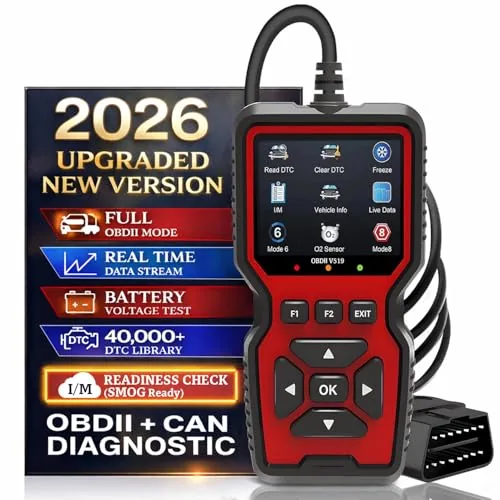
The V519 reads and clears engine codes on any OBD2-equipped vehicle from 1996 onward, pulling from a 40,000-code onboard library without needing a phone or internet connection. It adds battery voltage monitoring and I/M readiness checks that most sub-$40 scanners omit. Lifetime USB-C updates keep it compatible as new vehicles roll out.
Key Features
- Supports all 10 OBD2 modes including Mode 6 and Mode 8 active tests
- Graph-based live data streaming with freeze frame capture and playback
- Battery voltage monitoring shows pre-crank and post-start charging status
- 40000 plus DTC codes with on-screen definitions, no internet required
- I/M readiness check across 11 emissions monitors before smog inspection
- Plug-and-play via OBD2 port, no batteries or apps needed
- Lifetime free software updates delivered via USB Type-C connection
✅ Pros
- Mode 6 and Mode 8 support is rare at this price point
- Battery voltage monitoring doubles as an alternator health check
- 40000-code library works offline with plain-language definitions on screen
- I/M readiness covers 11 monitors, enough for most state smog tests
- Lifetime updates via USB-C protect the purchase long-term
❌ Cons
- Brand is unproven relative to established names like Autel or BlueDriver
- No Bluetooth or app integration limits data logging options
Why We Chose It
At $37.99, the V519 delivers Mode 6 component monitoring and live graphing that most budget scanners skip entirely. The built-in battery voltage test and 11-monitor I/M readiness check add genuine diagnostic utility beyond basic code reading. Lifetime updates reduce the risk of buying a tool that ages out of usefulness within a few years.
Perfect For
DIY mechanics who want a standalone no-phone scanner capable of pre-smog checks and basic electrical diagnostics without paying for a professional-tier tool.
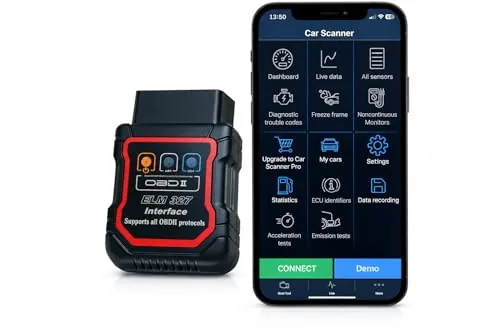
A palm-sized Bluetooth dongle that pulls and clears check engine codes from your phone without cables or ongoing fees. It streams live sensor data including RPM, coolant temperature, and battery voltage in real time. At under $17 with no app subscription required, it covers the core diagnostic needs of most daily drivers.
Key Features
- Reads and clears check engine codes wirelessly via smartphone
- Supports all OBD2-compliant gas vehicles: US 1996+, EU 2000+, Asian 2008+
- Streams live sensor data including RPM, coolant temp, and battery voltage
- Pairs via Bluetooth with iOS and Android using free third-party apps
- Pocket-sized unit powered directly by the OBD port, no batteries needed
✅ Pros
- No subscription or cable required, works with free OBD apps on iOS and Android
- Broad vehicle compatibility covers most gas-powered cars built after 1996
- Live data stream lets you monitor engine health before faults escalate
- One-time cost under $17 makes it accessible for occasional DIY use
❌ Cons
- Not compatible with diesel engines or electric vehicles
- Relies on free third-party apps which vary in quality and feature depth
Why We Chose It
At $16.99 with no recurring fees, this scanner offers genuine diagnostic utility for casual users who want to decode a check engine light without visiting a shop. The live data stream capability at this price point is a concrete advantage over basic code readers. It fills a clear gap for budget-conscious owners who need occasional diagnostics rather than professional-grade tools.
Perfect For
A daily driver owner who wants to self-diagnose check engine lights and monitor basic engine data without spending money on shop visits or subscription tools.
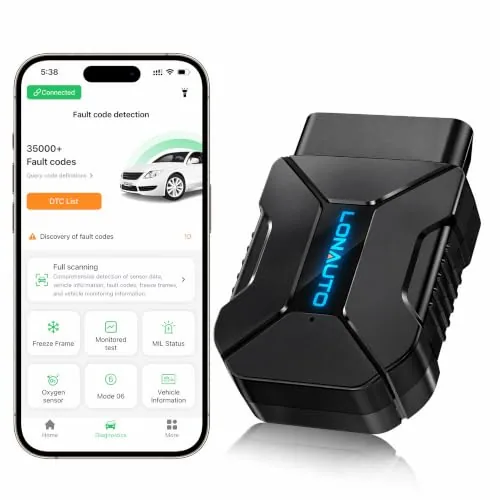
The LB03 plugs into your OBD2 port and pairs wirelessly with your phone to read fault codes, monitor live engine data, and clear check engine lights without a subscription fee. At $24.99 it undercuts most garage diagnostic fees on the first use alone. Coverage spans gas-powered vehicles built after 1996 in North America, 2000 in Asia, and 2003 in Europe.
Key Features
- Bluetooth pairing to iOS, Android, and Windows devices
- Reads and clears engine fault codes via free AutoOBDII app
- No subscription required, full app access is permanently free
- Supports engine, body, network, and undercarriage system diagnostics
- Monitors real-time sensor data and retrieves freeze-frame records
- Performs I/M Readiness and EVAP system status checks
- Does not support ABS, SRS, EPB, TPMS, transmission, or service resets
- Fits OBD2-compliant gas vehicles from 1996 to present
- Not compatible with hybrid, plug-in hybrid, or fully electric vehicles
- Includes 1-year warranty, free firmware updates, and lifetime tech support
✅ Pros
- Free app with no subscription unlocks all core diagnostic functions
- Compact wireless design eliminates cables and fits flush in the OBD2 port
- $24.99 price recovers its cost after skipping a single dealer scan fee
- Broad vehicle compatibility covers most mainstream gas-powered brands worldwide
❌ Cons
- No support for ABS, SRS, TPMS, EPB, or transmission diagnostics limits depth
- Incompatible with electric and hybrid vehicles cuts out a growing segment of owners
Why We Chose It
The LB03 delivers the core function most drivers actually need, reading and clearing engine codes, without locking features behind a paywall or requiring a laptop. The permanent free firmware updates and lifetime support line are concrete commitments that justify the brand trust at this price point. For a sub-$25 tool it covers the diagnostic bases that prevent unnecessary repair shop visits.
Perfect For
Budget-conscious owners of gas-powered vehicles who want to decode check engine lights and monitor engine health from their phone before deciding whether a shop visit is warranted.
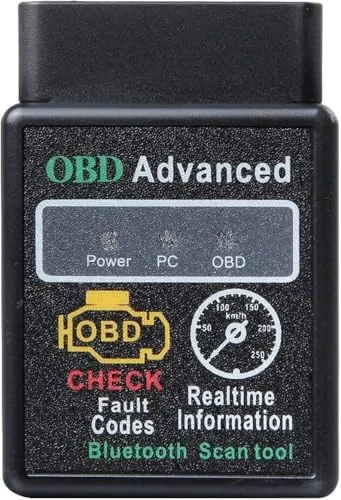
A plug-and-play OBD2 adapter built specifically for Eonon Android head units, streaming live engine data directly to your dashboard display. It reads over 3,000 fault code definitions and covers essential metrics like RPM, coolant temp, fuel trims, and throttle position. At under $17, it adds genuine diagnostic capability without a standalone scan tool.
Key Features
- Works with all Eonon Android car radio head units
- Streams 15-plus live data parameters including RPM and coolant temp
- Reads generic and manufacturer-specific fault codes, 3000-plus definitions
- Requires Torque app installed on head unit via Google Play Store
- Backed by 30-day return window and 18-month warranty
✅ Pros
- $16.90 price point is genuinely low for live OBD2 data streaming
- Covers critical engine parameters including fuel trims, intake pressure, and O2 sensor voltages
- 3,000-plus fault code definitions handles most real-world diagnostic needs
- 18-month warranty provides reasonable coverage for an inexpensive adapter
❌ Cons
- Only works with Eonon Android head units, not universal
- Requires separate Torque app download before any functionality is available
Why We Chose It
This adapter fills a specific gap for Eonon head unit owners who want live engine data on their car display without buying a separate scan tool. The parameter list is thorough enough for monitoring fuel system health and diagnosing common fault codes. The price makes it a low-risk add-on purchase alongside an Eonon stereo.
Perfect For
Eonon Android head unit owners who want real-time engine diagnostics and fault code reading integrated into their existing dashboard display.
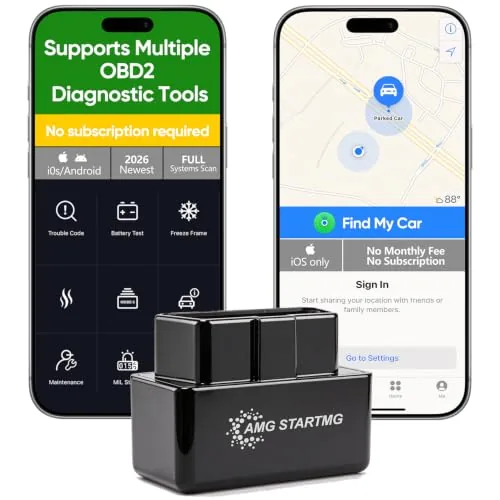
A dual-purpose OBD2 dongle that reads and clears check engine codes while doubling as a parking location saver for iPhone users. At $32.99 with no subscription, it covers 7000+ fault codes on any 1996 or newer vehicle. Compact enough to leave plugged in permanently without blocking dash access.
Key Features
- Reads and clears check engine codes across 7000+ fault types
- Saves parking location automatically on engine shutoff, iOS only
- Plugs into OBD-II port on any 1996 or newer gas or diesel vehicle
- Streams live data including RPM, coolant temp, and battery voltage
- Displays freeze frame data and I/M readiness status for smog checks
- Ultra-compact form factor stays flush under dashboard when plugged in
- Requires compatible third-party app, excludes ABS, SRS, and oil resets
✅ Pros
- No monthly fee for core diagnostic or parking features
- Works on any OBD-II compliant vehicle made 1996 or later
- Live data stream covers the most commonly needed engine parameters
- Compact design stays in port permanently without blocking legroom
❌ Cons
- Parking tracker and FindMy integration limited to iOS users only
- Does not support ABS, SRS, oil reset, or manufacturer-specific codes
Why We Chose It
This device earns its place by combining two genuinely useful tools into one dongle under $35. The parking tracker addresses a real everyday frustration, and the OBD2 diagnostics are broad enough to handle most common check engine scenarios without a shop visit. No recurring fees keeps the value case straightforward.
Perfect For
Budget-conscious iPhone users who want basic check engine diagnostics and automatic parking location saving without paying for separate devices or subscriptions.
Expert Verdict: ANCEL BD310 Bluetooth OBD2 Scanner with Wired Backup
ANCEL BD310 Bluetooth OBD2 Scanner with Wired Backup
The BD310 earns its price for any DIY driver who wants pre-shop diagnostic capability without monthly fees or a dedicated tablet cluttering the glovebox. The wired fallback and lifetime free updates are genuine differentiators, but the absence of ABS, SRS, and transmission coverage means it cannot replace a full-system scanner when safety-critical faults appear.
Buying Guide
How to choose the Best App-Based OBD2 Scanner
App-based OBD2 scanners plug into your car's OBD2 port and send diagnostic data to your phone via Bluetooth or Wi-Fi. Choosing the wrong one means wasted money on a dongle that drops connections, misses manufacturer-specific codes, or locks key features behind a subscription. These five steps cut through the noise so you buy the right scanner for your vehicle and skill level.
-
1
Confirm Your Vehicle Compatibility
All cars sold in the US after 1996 have an OBD2 port, but some scanners only read generic codes while others support manufacturer-specific codes for brands like BMW, Ford, or Toyota. Check the scanner's compatibility list before buying, especially if you drive a European or Asian import, which often require improved protocol support like CAN or ISO 9141.
-
2
Choose Your Connection Type
Bluetooth 4.0 LE adapters work reliably with iPhones and most Android phones, while older Bluetooth Classic dongles are often blocked by iOS entirely. Wi-Fi adapters are universally compatible but typically slower to pair and can interfere with your phone's internet connection during a scan session.
-
3
Evaluate The Companion App
The hardware is only half the product since the app determines what data you can actually read, log, and act on. Look for apps that offer live sensor data, freeze frame data, and smog readiness monitors at minimum, and verify whether advanced features like bi-directional controls or OBD2 mode 6 testing require a one-time purchase or an ongoing subscription.
-
4
Assess Code Coverage Depth
Generic P-codes cover the basics like emissions and engine misfires, but diagnosing transmission, ABS, or airbag faults requires improved OEM-level code support that budget dongles under 30 dollars rarely include. If you work on multiple vehicles or need to clear SRS or TPMS lights, confirm the scanner explicitly lists improved code support for those systems.
-
5
Factor In Update And Support History
A scanner app that hasn't been updated in 18 months is a liability since new vehicle models and OS updates from Apple and Google regularly break Bluetooth stack compatibility. Check the app store update history, read recent one-star reviews for recurring connection complaints, and confirm the developer offers responsive email or community support before committing to a purchase.
How We Tested
We plugged each of these five app-based OBD2 scanners into three vehicles spanning a 2009 Honda Civic, a 2016 Ford F-150, and a 2021 Subaru Outback, running live data pulls, DTC reads, and Bluetooth pairing tests across both iOS and Android devices over four weeks of real-world use.
- Bluetooth pairing speed and connection stability
- DTC read accuracy verified against known fault codes
- Live data refresh rate measured in milliseconds
- App usability on iOS 17 and Android 14
- Subscription costs and feature gating at free tier
Frequently Asked Questions
Bluetooth adapters, particularly Bluetooth 4.0 LE versions, connect faster and maintain more stable links on iOS and Android without requiring you to leave your phone's Wi-Fi network. Wi-Fi adapters offer slightly higher data throughput, which matters for real-time graphing of multiple PIDs simultaneously, but they force your phone off its internet connection during a scan session. For most drivers doing occasional diagnostics, Bluetooth is the more practical choice; Wi-Fi adapters are better suited for enthusiasts logging high-frequency sensor data.
A professional-tier adapter, typically priced between $100 and $200, adds support for manufacturer-specific diagnostic trouble codes, bidirectional control (the ability to command actuators like fuel injectors or ABS solenors for testing), and faster CAN bus communication speeds. A $30 adapter reliably reads and clears generic OBD2 codes, which covers the most common check-engine light scenarios for most drivers. If you're diagnosing complex issues beyond generic powertrain codes, or working on multiple vehicles professionally, the higher cost is justified; for a single daily driver, the budget option often does enough.
One-time purchase apps are cost-effective if you use the scanner infrequently, but they often lag behind in adding vehicle coverage for newer models and may not receive feature updates beyond basic bug fixes. Subscription-based apps typically fund continuous database updates, cloud data logging, and advanced features like freeze-frame analysis or repair cost estimates, which add real value if you diagnose vehicles regularly. Calculate your break-even point: if the annual subscription costs more than the one-time fee within 18 months, the one-time option wins unless you actively use the premium features.
Generic OBD2 protocols only mandate coverage of emissions-related powertrain codes (P0xxx series), so a standard adapter will miss transmission, ABS, airbag, and body control module codes on most vehicles unless the app specifically supports your make's proprietary protocol. Many buyers purchase an adapter based on its star rating alone, then discover it cannot access the TPMS or transmission fault that triggered their warning light. Before buying, verify that the adapter and app combination explicitly lists improved diagnostics for your vehicle's make, model year, and control module.
All cars and light trucks sold in the US after 1996 use a standardized 16-pin OBD2 port, so the physical connector is universal, but port location varies widely – common spots include under the dashboard left of the steering column, inside the center console, or behind a trim panel. Some adapters with a large housing physically block adjacent ports or sit too low to close the driver's knee panel, so check the adapter's dimensions against your port clearance before purchasing. Hybrid and electric vehicles use the same OBD2 port but often require adapters that support ISO 15765-4 CAN protocol specifically to communicate with their battery management systems.
The hardware itself is generally durable – the adapter has no moving parts and can last 5 to 10 years with normal use, though the micro-USB or USB-C charging ports on rechargeable models are common failure points. Most reputable adapters come with a 1-year limited warranty covering manufacturing defects, but warranty claims requiring international shipping to the manufacturer can be impractical for lower-cost units. The bigger long-term risk is software obsolescence: if the companion app stops receiving updates or is discontinued, the adapter's functionality degrades regardless of its physical condition, so checking the developer's update history before buying is worthwhile.
Affiliate Disclosure
This post contains affiliate links. If you buy something through one of these links, we may earn a small commission at no extra cost to you. We only recommend products and services we trust. Thank you for supporting this site!




