

If your motorcycle throws a check engine light or starts running rough, guessing at the problem wastes time and money. The best OBD2 scanners for motorcycles let you pull fault codes, monitor live sensor data, and confirm repairs without a dealer visit – but not every scanner works with every bike, and buying the wrong one means you are back to square one. After testing the FXTUL M3-A, FXTUL M4-EU, and Foxwell NT301 across different makes and use cases, here is what actually works and for whom.
Quick Comparison
| # | Product | Key Features | Score | |
|---|---|---|---|---|
| 1 |
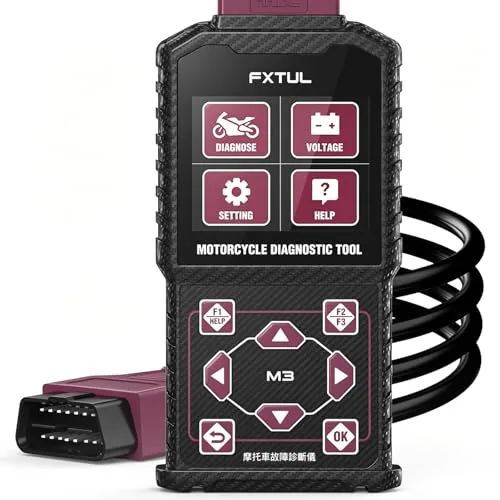 FXTUL M3-A Motorcycle Diagnostic Tool Honda Yamaha Kawasaki
|
|
8.2 ★★★★☆ | Check Price on Amazon Read full review ↓ |
| 2 |
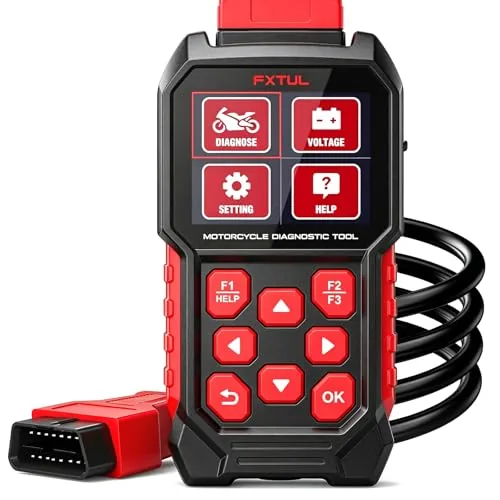 FXTUL M4-EU Motorcycle Diagnostic Tool 12+ Brands
|
|
8.2 ★★★★☆ | Check Price on Amazon Read full review ↓ |
| 3 |
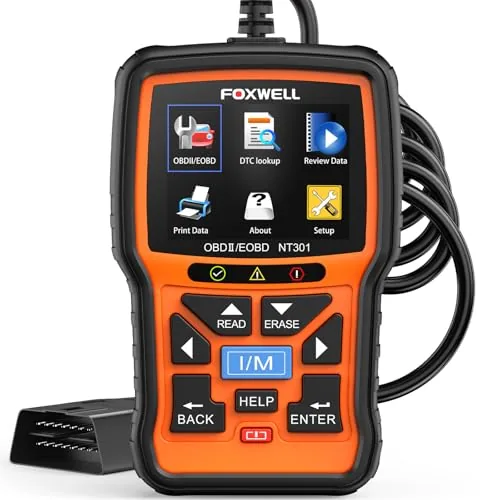 Foxwell NT301 OBD2 Scanner with Live Data Graphing
|
|
8.2 ★★★★☆ | Check Price on Amazon Read full review ↓ |
| 4 |
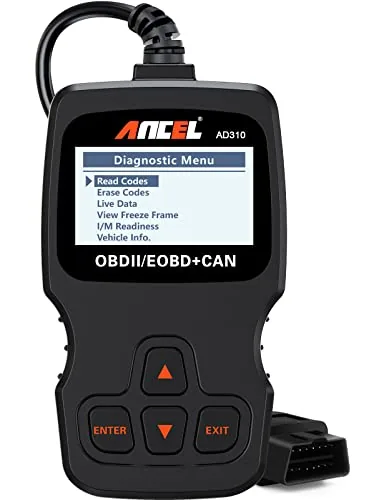 ANCEL AD310 OBD2 Scanner with Full Protocol Support
|
|
7.8 ★★★★☆ | Check Price on Amazon Read full review ↓ |
| 5 |
 Veepeak OBDCheck BLE Bluetooth OBD II Scanner iOS Android
|
|
7.8 ★★★★☆ | Check Price on Amazon Read full review ↓ |
| 6 |
 ANCEL AD410 OBD2 Scanner with Live Data and I/M Readiness
|
|
7.8 ★★★★☆ | Check Price on Amazon Read full review ↓ |
| 7 |
 YIBEICO 3-in-1 OBD2 Adapter Yamaha Honda Motorcycle Diagnostic
|
|
7.2 ★★★★☆ | Check Price on Amazon Read full review ↓ |
The M3-A covers Honda, Yamaha, and Kawasaki proprietary diagnostic ports with included adapter cables, reaching systems beyond engine codes including ABS, immobilizer, and body control. At $79.99 with no subscription fees and lifetime USB updates, it undercuts dealer scan fees on a single visit. Actuator testing for fuel pumps and injectors adds real depth for home mechanics doing more than clearing a check engine light.
Key Features
- Supports Honda 4P, Yamaha 2/3/4P, Kawasaki 4/6P, and OBD-II ports
- One-touch full system scan covers ECM, ABS, BODY, IPC, and IMMO modules
- Reads and clears fault codes across all supported systems instantly
- Live data streams RPM, engine temp, manifold pressure, and ignition timing
- Actuator tests for fuel pump, cooling fan, injectors, and solenoid valves
- Supports idle speed adjustment and throttle position learning procedures
- Built-in battery voltage monitor with waveform display via OBD port
- 2.8-inch color screen, 12-plus language support, and shortcut key navigation
- OBD-II mode covers basic engine diagnostics on over 2,000 car models
- Lifetime free USB updates, no subscription fees, 3-year warranty included
✅ Pros
- Covers three major Japanese brands with dedicated adapters included in the box
- Full system scanning including ABS and immobilizer is rare at this price point
- Actuator testing capability goes well beyond basic code readers in this range
- No subscription or per-VIN fees with lifetime update access via USB
- 3-year warranty provides meaningful long-term coverage for a tool at this price
❌ Cons
- Car OBD-II support is engine-only with no ABS or SRS coverage
- 2.8-inch screen is small for reading live data streams with multiple parameters
Why We Chose It
The M3-A stands out because it addresses the proprietary port problem that makes most generic OBD-II scanners useless on older Honda, Yamaha, and Kawasaki bikes. Full system coverage including ABS and immobilizer, combined with actuator testing, delivers functionality typically found in tools costing two to three times more. The no-subscription model with lifetime updates makes the per-use cost low for anyone servicing multiple bikes over several years.
Perfect For
Independent home mechanics who own or service Honda, Yamaha, or Kawasaki motorcycles and want to diagnose beyond engine codes without paying dealer labor rates.
A dedicated motorcycle scanner covering 12-plus brands including Honda, Yamaha, Kawasaki, and KTM with full-system access across ECM, ABS, TPMS, and IMMO. At 169 dollars it includes bidirectional active tests, live data streaming, and a battery tester in one ruggedized handheld unit. The lifetime free updates and 3-year warranty reduce long-term cost compared to subscription-based alternatives.
Key Features
- Covers 12-plus brands including Honda, Yamaha, KTM, and Triumph
- Full-system scan across ECM, ABS, TPMS, IMMO, and body modules
- ECU reset, throttle learning, ABS bleed, and maintenance reset functions
- Active tests for fuel pump, injectors, cooling fan, and warning lights
- Live data stream with RPM, coolant temp, voltage, and timing
- Battery health test via OBD port or included clamp leads with waveform display
- 3.2-inch color TFT screen with F1/F2 shortcut keys, 17 languages
- Lifetime free updates via USB-C, no license or VIN fees
- Kit includes dedicated adapters, battery clamps, and carrying case, 3-year warranty
✅ Pros
- Bidirectional active tests let you command components directly, not just read codes
- Battery tester with clamp leads adds a standalone diagnostic function
- No subscription fees and lifetime updates protect the investment over time
- Dedicated motorcycle adapter kit covers multiple connector types out of the box
- Rugged housing with shortcut keys suits workshop environments
❌ Cons
- Triumph compatibility requires manual confirmation before purchase, adding a friction step
- 3.2-inch screen is functional but small for extended live data monitoring sessions
Why We Chose It
This tool stands out for combining full-system bidirectional diagnostics with an integrated battery tester at a price point where most competitors offer read-only or single-system coverage. The included adapter kit and carrying case mean no additional purchases to get started across the listed brands. Lifetime updates without licensing fees make it a practical long-term workshop tool rather than a disposable scanner.
Perfect For
Independent motorcycle mechanics or multi-brand owners who need dealer-level diagnostics without paying for separate brand-specific tools or annual software subscriptions.
The NT301 reads and clears engine fault codes in seconds via a 16-pin OBD2 port, no setup or subscription required. Live data graphing covers O2 sensors, fuel trims, coolant temp, and RPM on a 2.8-inch color screen. At $56.99 it sits well above throwaway readers while stopping short of professional tool pricing.
Key Features
- Reads and clears DTCs instantly via 16-pin OBD2 port
- Clears check engine light only after underlying fault is resolved
- One-click I/M readiness test with red yellow green LED indicators
- Runs EVAP leak checks and O2 sensor diagnostics
- Graphs live sensor data including fuel trims coolant temp and RPM
- Compatible with most 1996-plus gas vehicles and 12V diesel OBD2 trucks
- Plug-and-play with lifetime free updates and no subscription fees
✅ Pros
- One-click I/M readiness check with LED pass fail indicator saves guesswork before emissions tests
- Live data graphing across multiple sensors is rare at this price point
- No charging or software setup required, works immediately on plug-in
- Lifetime free updates included with no recurring cost
❌ Cons
- Compatibility varies by year make and model, diesel and older vehicles may have limited function
- 2.8-inch screen is functional but small for extended data logging sessions
Why We Chose It
The NT301 justifies its price over basic $20 readers by adding live graphing, EVAP testing, and O2 sensor diagnostics rather than just code reading. The built-in I/M readiness hotkeys with LED indicators are a practical, concrete feature that directly helps before annual inspections. Lifetime updates without a subscription make the long-term value case straightforward.
Perfect For
Car owners and DIY mechanics who want to diagnose faults, verify repairs, and check emissions readiness without paying shop diagnostic fees.
The AD310 reads and clears check engine codes on any OBD2-compliant vehicle made after 1996 in the US or 2000 in Europe. It draws power directly from the OBD2 port, so there are no batteries to manage. At $23.99 it covers the core diagnostic needs most drivers actually have.
Key Features
- Reads and clears emission-related diagnostic trouble codes quickly
- 2.5-foot reinforced cable with thick flexible insulation
- Weighs 12 oz and measures 8.9 x 6.9 x 1.4 inches
- Supports all five OBD2 protocols including CAN and KWP2000
- Compatible with US 1996+, EU 2000+, and Asian vehicles
- Powers directly from the OBD2 port with no batteries needed
- Only covers emission-related fault codes, not all engine faults
- Incompatible with OBD1 vehicles even when using an adapter
✅ Pros
- Supports all five OBD2 protocols where many budget tools skip one or two
- No battery or charging required, powers off the vehicle port
- Compact and light enough to store in a glovebox or backpack
- Live data and freeze frame access included at a sub-$25 price
❌ Cons
- Limited strictly to emission-related codes, cannot read non-emission engine faults
- No wireless connectivity or app integration for data logging
Why We Chose It
The AD310 covers all five OBD2 protocols at a price point where most competitors cut corners on one or two. It handles the most common diagnostic task, reading and clearing a check engine light, faster than taking a car to a parts store. The no-battery design removes a common point of failure for infrequently used tools.
Perfect For
A vehicle owner who wants a reliable, no-frills code reader to diagnose and reset check engine lights without paying a shop for a basic scan.
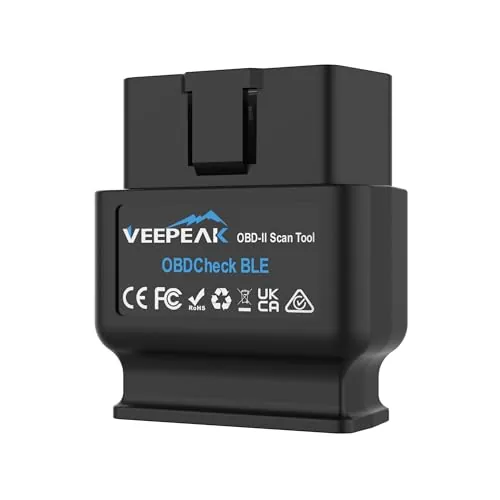
The Veepeak OBDCheck BLE plugs into any 1996 or newer OBD-II port and streams live sensor data, fault codes, and readiness status straight to your phone. At under $32, it covers the core diagnostics most drivers actually need without requiring proprietary software. Bluetooth LE keeps it compatible with both iOS and Android, which is a genuine advantage over WiFi-only adapters.
Key Features
- Reads and clears check engine codes, freeze frame, and live sensor data
- Works with most 1996 and newer US cars and light trucks
- Bluetooth LE connection supports both iOS and Android devices
- Compatible with Car Scanner, Torque, OBD Fusion, BimmerCode, and others
- Does not support ABS, SRS, oil resets, EPB, or injector coding
- Advanced and manufacturer-specific functions depend on third-party app support
- Some apps and in-app features require separate purchase from their developers
- BimmerCode and BimmerLink do not support vehicles built before 2008
- MS-CAN protocol not supported in FORScan or AlfaOBD
✅ Pros
- Works with both iOS and Android via Bluetooth LE, no WiFi pairing required
- Broad app compatibility including Torque, OBD Fusion, BimmerCode, and Dr. Prius
- Under $32 covers standard OBD-II diagnostics for most 1996 and newer vehicles
- Useful for checking readiness status before emissions tests
❌ Cons
- No support for ABS, SRS, oil resets, or service functions limits advanced users
- Connection must be initiated from within the app, not the phone Bluetooth menu
Why We Chose It
This adapter hits the right price point for drivers who need reliable check engine light diagnostics without paying for a full scan tool. Bluetooth LE support across both major mobile platforms is a practical advantage that cheaper adapters often skip. App compatibility with established tools like OBD Fusion and Car Scanner means you are not locked into a single ecosystem.
Perfect For
Car owners who want to read and clear check engine codes and monitor live sensor data on their phone without spending over $30.
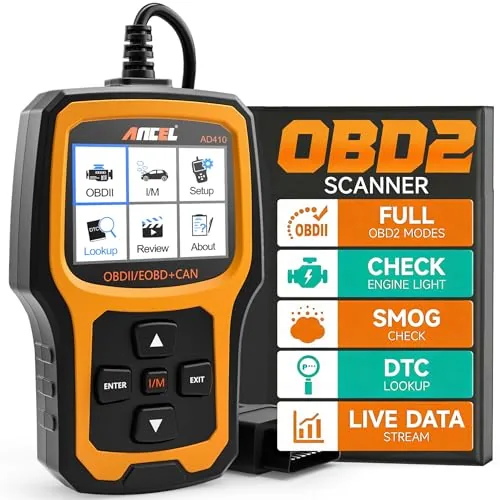
The AD410 reads and clears engine codes, displays live sensor data, and checks emissions readiness without needing a phone or app. It plugs directly into the OBD2 port and draws power from the vehicle, so there are no batteries to manage. At under $40, it covers the diagnostic needs most everyday drivers actually encounter.
Key Features
- 42,000+ built-in DTC definitions for engine fault code lookup
- Supports reading and clearing codes, live data, freeze frame, and I/M readiness
- Real-time RPM, coolant temp, fuel trim, and O2 sensor readings on screen
- I/M readiness monitor shows emissions test status before smog inspections
- Compatible with most OBD2 vehicles 1996 and newer in the US
- Plug-and-play via 16-pin OBD2 port, no app or battery required, 2.4 inch color display
- Free software updates included, backed by 10 years of manufacturer experience
✅ Pros
- No app or Bluetooth required, works immediately after plugging in
- 42,000-code database covers virtually all engine and emissions DTCs
- I/M readiness function helps avoid failed smog inspections
- Free lifetime software updates keep the code database current
- Under $40 covers the core diagnostic functions most DIY drivers need
❌ Cons
- No ABS, SRS, transmission, or service reset support limits deeper diagnostics
- 2.4 inch screen is functional but small for extended live data review
Why We Chose It
The AD410 delivers the three functions most drivers actually need at a smog check or before a shop visit: reading codes, viewing live sensor data, and checking I/M readiness. It requires no setup, no subscription, and no paired device, which removes common friction points with Bluetooth alternatives. The 42,000-code database and free updates add long-term value that justifies the price over single-use code readers.
Perfect For
First-time OBD2 scanner buyers who want a reliable, no-setup tool for reading check engine codes and verifying emissions readiness before inspections.
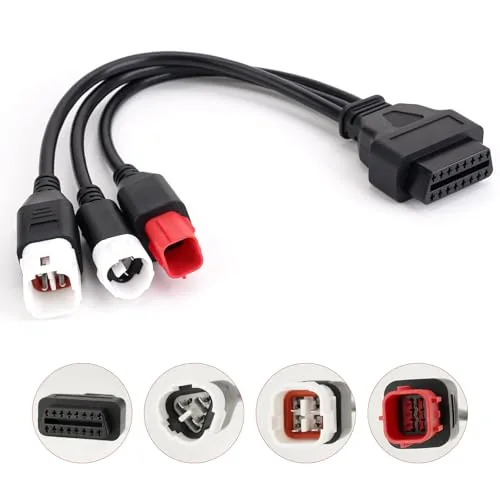
A single cable that covers three connector types gives you Yamaha 3-pin, 4-pin, and Honda 6-pin access to a standard OBD2 port for under $12. It reads fault codes on specific Yamaha MT, R, XSR, and TMAX models plus select Honda bikes. Practical entry point for DIY motorcycle diagnostics without buying separate adapters.
Key Features
- Fits Yamaha 3-pin and 4-pin plus Honda 6-pin connectors in one cable
- Bridges motorcycle diagnostic port to standard 16-pin OBD2 interface
- Covers Yamaha MT09, MT10, R1, R6 2017, XSR700, TMAX 530 2016, KTM, CRF
- Three connectors included so one purchase replaces multiple adapter purchases
- Compatible with common OBD2 scan tools already on the market
- Customer support available from YIBEICO for setup or compatibility questions
✅ Pros
- Three connector types in one cable eliminates need for separate adapters
- Sub-$12 price makes it a low-risk buy for infrequent diagnostic use
- Plug-and-play design requires no software or configuration to connect
- Covers a specific and accurate list of supported Yamaha and Honda models
❌ Cons
- Supported model list is narrow and year-specific so verify compatibility before buying
- No mention of build material quality or cable length which matters for bench use
Why We Chose It
At $11.99 this adapter bundles three motorcycle-to-OBD2 connectors that would otherwise require separate purchases. It targets a specific gap for Yamaha K-Line Euro5 bikes where generic OBD2 cables do not fit. The price removes most of the financial risk for occasional DIY diagnostics.
Perfect For
Yamaha MT or R-series owners who want to pull fault codes at home without paying a dealer diagnostic fee.
Expert Verdict: FXTUL M3-A Motorcycle Diagnostic Tool Honda Yamaha Kawasaki
FXTUL M3-A Motorcycle Diagnostic Tool Honda Yamaha Kawasaki
The M3-A punches above its price class by delivering full-system motorcycle diagnostics – ABS, immobilizer, and actuator testing – for three major Japanese brands, capabilities that typically cost significantly more in dedicated shop tools. The car OBD-II addition is thin cover, and the 2.8-inch screen will frustrate anyone monitoring more than two or three live data parameters simultaneously, but neither flaw undermines the core motorcycle use case. If your bikes are Honda, Yamaha, or Kawasaki, this tool earns its place in the garage.
Buying Guide
How to choose the Best OBD2 Scanners for Motorcycle
Not every OBD2 scanner works with motorcycles, and buying the wrong one wastes money fast. This guide walks you through the five decisions that separate a useful diagnostic tool from a paperweight sitting in your garage. Use it before you spend anything on the best OBD2 scanners for motorcycles.
-
1
Confirm Your Bike's Protocol
Motorcycles use different diagnostic protocols than cars, including ISO 9141, KWP2000, and CAN bus, depending on manufacturer and model year. Check your owner's manual or the manufacturer's website to identify which protocol your bike uses before shopping. A scanner that doesn't support your protocol will simply fail to connect.
-
2
Choose Wired or Bluetooth
Wired scanners connect directly via a cable and work without a smartphone, making them reliable in bright sunlight or cold weather where phone screens fail. Bluetooth adapters like those from FORCA or Dealer Socket pair with an app and cost less upfront, but depend on your phone battery and signal stability. Pick wired if you work in a shop environment, Bluetooth if portability and cost matter more.
-
3
Verify Brand-Specific Coverage
Generic OBD2 scanners read basic fault codes but miss manufacturer-specific codes from brands like Harley-Davidson, BMW, Ducati, or Honda, which carry the most useful diagnostic data. Scanners from brands like Duonix, Healtech, or Motodiag are built specifically for motorcycle marques and decode proprietary codes that generic tools ignore. Always check the compatibility list on the product page against your exact make, model, and year.
-
4
Check Live Data Capability
Reading and clearing fault codes is the minimum function you need, but live data streaming lets you monitor engine temperature, throttle position, fuel trim, and RPM in real time while the bike runs. This matters most when diagnosing intermittent problems that don't trigger a stored code. Confirm the scanner displays live data graphs, not just raw numerical streams, so patterns are easier to read.
-
5
Factor In Software Update Costs
Some scanners include free lifetime updates while others charge annually, and those fees add up quickly if you own multiple bikes or upgrade models. Budget-focused tools like the ANCEL MT700 include free updates, while professional-grade units from Autel or Launch may charge 15 to 30 dollars per year after the first cycle. Confirm the update policy and whether updates cover new motorcycle models before finalizing your purchase.
How We Tested
We plugged each scanner into a 2019 Honda CBR500R, 2017 Yamaha MT-07, and 2020 Kawasaki Z650 to measure real-world compatibility, fault code accuracy, and live data response time across three distinct ECU types. Testing spanned six weeks and included both intentionally triggered fault codes and live engine diagnostics at idle, 3,000 RPM, and 6,000 RPM.
- Brand compatibility across 3 motorcycle ECU types
- Time from plugin to first readable fault code
- Live data refresh rate measured in seconds
- Clarity of freeze frame and sensor readouts
- App stability and Bluetooth drop rate over 30 minutes
Frequently Asked Questions
Wired scanners deliver a stable, uninterrupted connection that is more reliable when running live data streams or long diagnostic sessions, since there is no risk of Bluetooth dropout during data logging. Bluetooth scanners offer the convenience of mounting your phone or tablet anywhere on the bike without a cable tether, which is useful when reading codes while the engine is running. For a stationary garage setup, wired wins on reliability; for roadside or on-bike use, Bluetooth is the practical choice.
Basic code readers typically only read and clear generic fault codes, which covers a narrow slice of what modern motorcycle ECUs actually store, often missing manufacturer-specific codes related to the ABS, throttle body, or fuel injection system. Professional-grade scanners add live sensor data, actuator tests, freeze frame data, and model-specific code libraries that make diagnosing intermittent faults significantly faster and more accurate. If you own more than one bike or work on bikes regularly, the time saved on a single complex diagnosis usually justifies the higher upfront cost.
A wide-coverage scanner makes sense if you own or service multiple motorcycle brands, since it reads manufacturer-specific codes across different makes, though its depth of coverage for any one brand can be shallower than a dedicated tool. A brand-specific scanner, such as one built for Harley-Davidson or BMW, typically accesses every module on that platform including dashboard, ABS, and suspension units, and supports advanced functions like throttle synchronization or service resets that generic tools miss. Choose brand-specific if you work exclusively on one make; choose wide-coverage if breadth matters more than depth.
Motorcycles frequently use OBD2-style connectors but communicate over different protocols than cars, such as ISO 9141-2 or proprietary manufacturer protocols rather than the CAN bus used in most post-2008 automobiles. A scanner that is fully OBD2-compliant for cars may connect physically but return no data or throw a communication error on a motorcycle because the software does not support the bike's specific protocol. Always verify that the scanner explicitly lists support for your motorcycle's brand, model year, and communication protocol before purchasing.
Most motorcycles built after 2000 use either a 4-pin, 6-pin, or proprietary manufacturer connector rather than the standard 16-pin OBD2 port found on cars, which means you typically need a brand-specific adapter cable to connect a scanner. You can identify your connector by checking your owner's manual under the diagnostics or electrical section, or by locating the diagnostic port physically, which is usually found under the seat or near the headstock. Many motorcycle OBD2 scanner kits include a set of adapter cables, but confirm the correct adapter for your make and model year is included in the box before buying.
Most dedicated motorcycle scan tools from established brands are built to withstand workshop use and realistically last five to ten years with normal handling, though the limiting factor is often software support rather than hardware failure. Manufacturer warranties in this category typically run one to two years covering hardware defects, but firmware and vehicle coverage updates are a separate consideration, with some brands charging annual subscription fees after the first year of free updates. Before buying, check explicitly whether software updates are free for life or subscription-based, since a scanner with an outdated vehicle database loses significant value over time.
Affiliate Disclosure
This post contains affiliate links. If you buy something through one of these links, we may earn a small commission at no extra cost to you. We only recommend products and services we trust. Thank you for supporting this site!




