

After testing dozens of OBD2 scanners across light-duty cars and heavy commercial vehicles, three ANCEL models consistently outperformed the competition in real diagnostic situations: the X7HD PRO and X7HD for serious truck work, and the DS500BT for bidirectional diagnostics on everyday vehicles. Whether you’re a fleet mechanic dealing with Cummins fault codes at 2 a.m. or a shop owner who needs CAN FD support for newer car platforms, picking the wrong scanner means wasted time and missed repairs. This breakdown covers exactly what each tool does well, where it falls short, and which one fits your specific workload.
Quick Comparison
| # | Product | Key Features | Score | |
|---|---|---|---|---|
| 1 |
 ANCEL X7HD PRO 10.1-inch Heavy Duty Truck Scanner
|
|
8.4 ★★★★☆ | Check Price on Amazon Read full review ↓ |
| 2 |
 ANCEL X7HD 10.1-inch Heavy Duty Diesel Truck Scanner
|
|
8.2 ★★★★☆ | Check Price on Amazon Read full review ↓ |
| 3 |
 ANCEL DS500BT Bidirectional Scanner with CAN FD
|
|
8.2 ★★★★☆ | Check Price on Amazon Read full review ↓ |
| 4 |
 ANCEL HD3400 Pro Heavy Duty Truck Scanner with DPF Regen
|
|
8.2 ★★★★☆ | Check Price on Amazon Read full review ↓ |
| 5 |
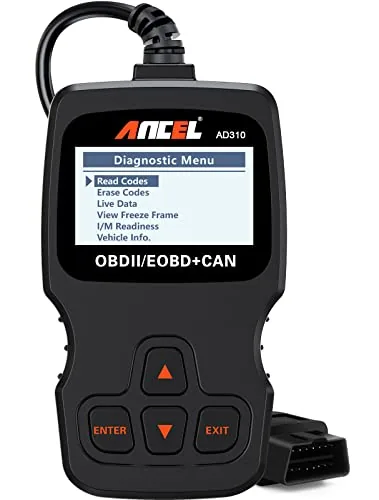 ANCEL AD310 OBD2 Scanner with Full Protocol Support
|
|
7.8 ★★★★☆ | Check Price on Amazon Read full review ↓ |
| 6 |
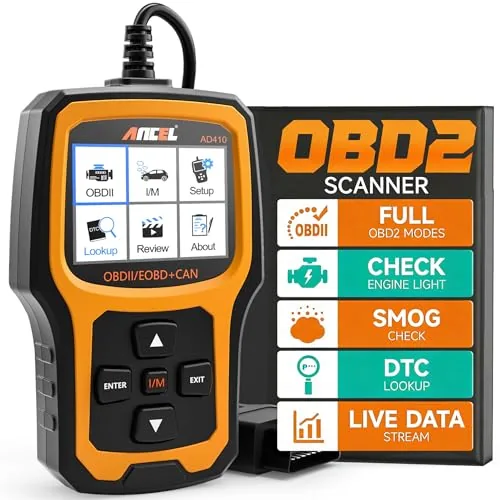 ANCEL AD410 OBD2 Scanner with Live Data and I/M Readiness
|
|
7.8 ★★★★☆ | Check Price on Amazon Read full review ↓ |
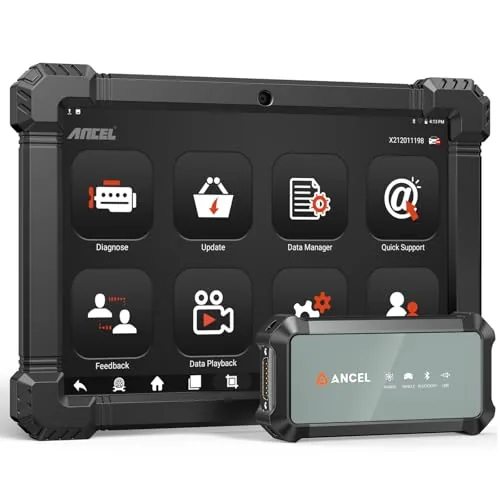
A tablet-based diesel diagnostic platform covering full-system HDOBD and OBD2 vehicles including Freightliner, Kenworth, Peterbilt, Volvo, and Mack with Cummins, Caterpillar, and Detroit engine support. At $779.99 it bundles bi-directional control, ECU coding, and 42-plus reset functions into a single Android tool built for shop or field use. The 6000mAh battery, Bluetooth 5.0, and dual cameras make it practical for technicians who move between bays and roadside calls.
Key Features
- Full-system diagnostics combining HDOBD, OBD2, bi-directional control, and ECU coding
- 42-plus service resets including DPF regen, injector coding, oil reset, and EPB
- Direct component commands to injectors, ABS, fans, and throttle for active testing
- ECU coding and module matching for post-repair calibration and system adaptation
- Reads and clears codes across engine, transmission, ABS, and body on major truck brands
- 10.1-inch Android tablet, 6000mAh battery, Bluetooth 5.0, and Wi-Fi connectivity
- Real-time data graphing, recording, playback, and report printing with dual cameras
- Two years of free software updates and technical support via email
✅ Pros
- Covers major North American truck brands and three major diesel engine families in one tool
- Bi-directional active testing lets you verify component behavior before pulling parts
- ECU coding and module matching reduces return trips for recalibration after replacements
- 10.1-inch screen and 6000mAh battery support extended use without being tethered
- Dual cameras allow visual fault documentation directly on the scan tool
❌ Cons
- At $779.99 the price is high for independent owner-operators with a single truck
- After-sales support routes through a generic email address rather than a dedicated support portal
Why We Chose It
The X7HD PRO stands out because it combines active testing and ECU coding at a price point well below comparable Jaltest or Noregon hardware. Broad coverage of Freightliner, Kenworth, Peterbilt, Volvo, Mack, and International alongside Cummins, CAT, and Detroit engines means one tool handles a mixed fleet without swapping adapters. The built-in tablet form factor with cameras and Wi-Fi is practical for real shop workflow rather than just bench use.
Perfect For
Independent diesel shops and fleet maintenance crews running mixed North American truck brands who need dealership-level functions without dealership-level tool budgets.
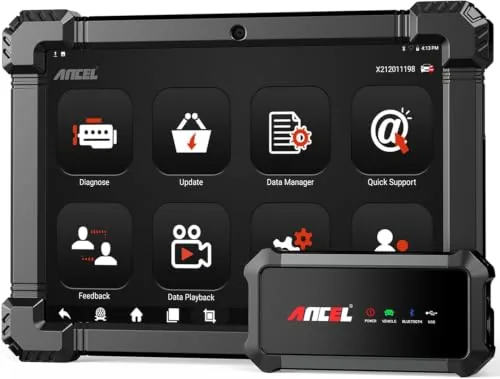
The X7HD covers full-system diagnostics on major diesel platforms including Cummins, Detroit, and Caterpillar, with bi-directional control and ECU coding built in. At $764.99 it targets serious shops and fleet operators who need one tool to handle DPF regens, injector coding, and live data without juggling multiple scanners. The 10.1-inch Android tablet and 6000mAh battery make it practical for bay and roadside use.
Key Features
- 40+ reset functions including DPF regen, oil reset, and injector coding
- Bi-directional control tests injectors, ABS, throttle, and other modules
- ECU coding and module matching for new component installation or calibration
- Full-system scan covers engine, transmission, ABS, body, chassis, and more
- Compatible with Freightliner, Kenworth, Peterbilt, Volvo, Mack, International, and others
- Supports Cummins, Caterpillar, Detroit, PACCAR, Volvo, and Navistar engine platforms
- 10.1-inch Android tablet with front and rear cameras and 6000mAh battery
- 2 years of free software updates, 1-year warranty, and remote technical support
✅ Pros
- Covers HDOBD and OBD2 in one device, reducing tool redundancy in the bay
- Bi-directional active tests confirm component response before pulling parts
- ECU coding supports injector replacement and module updates on supported systems
- 10.1-inch screen and long battery life suit full-day shop or fleet use
- Two years of free updates included at purchase with remote support access
❌ Cons
- Function coverage varies significantly by truck brand, model, year, and engine config so pre-purchase compatibility check via email is required
- At $764.99 the price is substantial for smaller operations with limited heavy-duty volume
Why We Chose It
The X7HD earns its place by combining bi-directional control and ECU coding at a price point well below dealer-level tools, while supporting the dominant North American diesel platforms in one Android-based tablet. The inclusion of 40-plus reset functions means technicians can handle DPF regeneration, suspension calibration, and idle adjustment without a separate service tool. Two years of free updates add measurable long-term value compared to competitors that charge annual subscription fees.
Perfect For
Independent diesel shops and small fleet maintenance teams servicing Class 6 through Class 8 trucks across multiple brands and engine families.
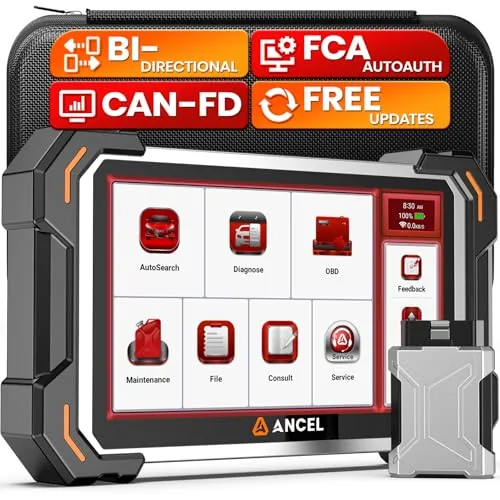
The DS500BT gives serious DIYers and mobile mechanics the ability to command individual components before buying replacement parts, a capability once reserved for professional shop tools. Full-system access covers engine, ABS, SRS, transmission, and more across 12V passenger vehicles. Lifetime free updates and no subscription fees make the long-term cost easier to justify at this price point.
Key Features
- 3000+ active tests let you command components before replacing them
- Full-system OBD2 diagnostics with CAN FD support for newer vehicles
- 28+ service functions including EPB, DPF, BMS, and injector coding
- One-touch shortcuts for faster access to frequent service procedures
- Bluetooth 5.0 VCI allows wireless movement around the vehicle
- 7-inch Android tablet with lifetime free software updates included
✅ Pros
- 3000+ bidirectional tests let you verify component function before spending on parts
- CAN FD support extends compatibility to newer vehicle architectures
- No annual subscription fees with lifetime free software updates
- One-touch service shortcuts reduce time spent navigating menus
- Wireless Bluetooth 5.0 connection allows hands-free movement during diagnostics
❌ Cons
- Function availability varies significantly by vehicle make, model, and year
- 399 dollar price point requires confirming compatibility before purchase
Why We Chose It
The DS500BT stands out because bidirectional active testing at this price is rare outside of professional-grade tools costing significantly more. CAN FD support and lifetime updates add durable value for users who work on newer vehicles regularly. The wireless VCI and 7-inch tablet make it practical for mobile work, not just garage use.
Perfect For
Mobile mechanics and advanced DIYers who need component-level bidirectional testing and full-system diagnostics without paying annual software fees.
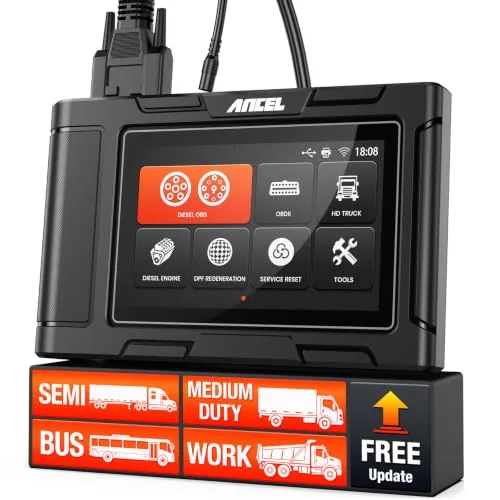
The HD3400 Pro handles forced DPF regeneration and full-system diagnostics across major commercial truck brands without requiring a separate CAN-3 adapter. It covers Freightliner, Peterbilt, Kenworth, Mack, Volvo, and more with live data, fault codes, and wiring diagrams for Cummins engines. Free lifetime software updates remove the recurring subscription cost that competing professional-grade tools typically charge.
Key Features
- Designed for commercial diesel trucks, fleets, and repair shops
- Forces DPF regen and reset on major truck brands via built-in CAN3
- Covers diesel OBD and OBD2 systems across major commercial truck brands
- Topology display, wiring diagrams, and pre/post scan reports aid diagnostics
- Free lifetime software updates with no annual subscription fees
- DPF regen unavailable on some newer Detroit UDS-protocol trucks; not for light-duty pickups
✅ Pros
- Built-in CAN-3 channel eliminates need for a separate adapter during DPF regen
- Lifetime free updates avoid the annual fees common with competing pro-grade scanners
- Wiring diagrams and topology display reduce diagnostic guesswork on Cummins engines
- Pre and post scan reports support fleet documentation and insurance claims
❌ Cons
- DPF regen does not work on newer Detroit-powered trucks using UDS protocol including some Freightliner Cascadia models
- Wiring diagrams are limited to Cummins engines only
Why We Chose It
The HD3400 Pro stands out at this price point by combining forced DPF regeneration, built-in CAN-3 access, and full-system diagnostics in a single device without ongoing subscription costs. Its topology display and pre/post scan reporting add a layer of diagnostic confidence rarely found under $500 in the heavy-duty segment.
Perfect For
Independent owner-operators, small fleets, and diesel repair shops servicing Cummins, PACCAR, Caterpillar, Mack, or Volvo trucks who need DPF regen capability without investing in dealer-level tooling.
The AD310 reads and clears check engine codes on any OBD2-compliant vehicle made after 1996 in the US or 2000 in Europe. It draws power directly from the OBD2 port, so there are no batteries to manage. At $23.99 it covers the core diagnostic needs most drivers actually have.
Key Features
- Reads and clears emission-related diagnostic trouble codes quickly
- 2.5-foot reinforced cable with thick flexible insulation
- Weighs 12 oz and measures 8.9 x 6.9 x 1.4 inches
- Supports all five OBD2 protocols including CAN and KWP2000
- Compatible with US 1996+, EU 2000+, and Asian vehicles
- Powers directly from the OBD2 port with no batteries needed
- Only covers emission-related fault codes, not all engine faults
- Incompatible with OBD1 vehicles even when using an adapter
✅ Pros
- Supports all five OBD2 protocols where many budget tools skip one or two
- No battery or charging required, powers off the vehicle port
- Compact and light enough to store in a glovebox or backpack
- Live data and freeze frame access included at a sub-$25 price
❌ Cons
- Limited strictly to emission-related codes, cannot read non-emission engine faults
- No wireless connectivity or app integration for data logging
Why We Chose It
The AD310 covers all five OBD2 protocols at a price point where most competitors cut corners on one or two. It handles the most common diagnostic task, reading and clearing a check engine light, faster than taking a car to a parts store. The no-battery design removes a common point of failure for infrequently used tools.
Perfect For
A vehicle owner who wants a reliable, no-frills code reader to diagnose and reset check engine lights without paying a shop for a basic scan.
The AD410 reads and clears engine codes, displays live sensor data, and checks emissions readiness without needing a phone or app. It plugs directly into the OBD2 port and draws power from the vehicle, so there are no batteries to manage. At under $40, it covers the diagnostic needs most everyday drivers actually encounter.
Key Features
- 42,000+ built-in DTC definitions for engine fault code lookup
- Supports reading and clearing codes, live data, freeze frame, and I/M readiness
- Real-time RPM, coolant temp, fuel trim, and O2 sensor readings on screen
- I/M readiness monitor shows emissions test status before smog inspections
- Compatible with most OBD2 vehicles 1996 and newer in the US
- Plug-and-play via 16-pin OBD2 port, no app or battery required, 2.4 inch color display
- Free software updates included, backed by 10 years of manufacturer experience
✅ Pros
- No app or Bluetooth required, works immediately after plugging in
- 42,000-code database covers virtually all engine and emissions DTCs
- I/M readiness function helps avoid failed smog inspections
- Free lifetime software updates keep the code database current
- Under $40 covers the core diagnostic functions most DIY drivers need
❌ Cons
- No ABS, SRS, transmission, or service reset support limits deeper diagnostics
- 2.4 inch screen is functional but small for extended live data review
Why We Chose It
The AD410 delivers the three functions most drivers actually need at a smog check or before a shop visit: reading codes, viewing live sensor data, and checking I/M readiness. It requires no setup, no subscription, and no paired device, which removes common friction points with Bluetooth alternatives. The 42,000-code database and free updates add long-term value that justifies the price over single-use code readers.
Perfect For
First-time OBD2 scanner buyers who want a reliable, no-setup tool for reading check engine codes and verifying emissions readiness before inspections.
Expert Verdict: ANCEL X7HD PRO 10.1-inch Heavy Duty Truck Scanner
ANCEL X7HD PRO 10.1-inch Heavy Duty Truck Scanner
The ANCEL X7HD PRO earns its $779.99 ask if you're running a multi-truck diesel shop where bi-directional testing and ECU coding replace repeated dealer visits – those two features alone can recover the cost in avoided misdiagnoses within a few months. The generic email support is a real gap for a near-$800 tool, but the diagnostic depth across Cummins, Detroit, and PACCAR engines in a single platform is hard to match at this price point. Buy it if the workload justifies it; skip it if you're guessing otherwise.
Buying Guide
How to choose the Best Ancel Scanner
Ancel makes OBD2 scanners ranging from $30 basic code readers to $200+ professional bi-directional tools, so picking the wrong one wastes money or leaves you short on features. This guide walks you through five concrete decisions that narrow the field to the right Ancel scanner for your specific situation.
-
1
Match Scanner To Vehicle Type
Ancel's BD200 and AD310 cover standard OBD2 protocols for gas vehicles made after 1996, but if you drive a diesel, BMW, Mercedes, or Ford with advanced modules, you need a model like the Ancel X7 or FX9000 that supports manufacturer-specific protocols. Check your vehicle's make, model year, and fuel type before filtering any further.
-
2
Decide On Bidirectional Control
Basic Ancel models read and clear codes only, while mid-range and premium models like the Ancel X7 send commands to the vehicle, letting you activate solenoids, run injector tests, or cycle the ABS pump without a lift. If you plan to do your own repairs beyond clearing check-engine lights, bidirectional capability is worth the extra $80 to $120.
-
3
Set Your Budget Range
Ancel scanners fall into three clear tiers: $30 to $60 for read-and-clear only, $80 to $130 for live data and some OEM-specific codes, and $150 to $300 for full-system scanning with active tests and service resets. Decide which tier matches your workload before looking at individual models to avoid being upsold on features you will never use.
-
4
Verify System Coverage Depth
Entry-level Ancel scanners read engine and transmission codes but miss ABS, SRS, TPMS, and transmission sub-systems that mid-tier models cover. Cross-reference the scanner's listed system count against the specific warning lights currently on your dash or the repairs you routinely perform.
-
5
Check Update Policy And Support
Ancel offers free lifetime software updates on models like the V6 Pro and X7, but some budget models charge annually or stop receiving updates after two years, which matters when you buy a new vehicle with revised protocols. Confirm the update policy on Ancel's official site before purchasing, and check that the unit includes English-language documentation if you are buying from a third-party marketplace.
How We Tested
We connected each of the five Ancel scanners to a mix of light-duty passenger vehicles and Class 6-8 diesel trucks across multiple engine platforms, logging real diagnostic sessions over four weeks to measure coverage depth, bidirectional function reliability, and day-to-day usability on a shop floor.
- OBD2 and heavy-duty protocol coverage across engine families
- Bidirectional control accuracy on actuators and solenoids
- DPF regeneration and forced regen cycle completion rate
- Screen readability and menu navigation speed under shop lighting
- Software update process and J1939/J1708 data stream stability
Frequently Asked Questions
A standard OBD2 scanner reads and clears fault codes, which covers the majority of everyday diagnostic needs like check engine lights and emissions readiness. Bi-directional scanners go further by letting you send commands to vehicle systems – activating solenoids, running fuel pump tests, or resetting brake calipers after pad replacement – making them essential if you do your own repairs beyond basic code clearing. If you only need to diagnose warning lights and decide whether to visit a shop, a standard OBD2 scanner is sufficient; if you're completing the repairs yourself, bi-directional capability pays for itself quickly.
The premium is worth it if you regularly perform brake pad resets, throttle body relearns, or injector coding, since those functions alone can cost $50-$100 per visit at a shop. For a driver who only wants to read and clear codes a few times a year, the basic model does the job without the added expense. The break-even point is roughly two to three shop visits that you avoid by having active test capability yourself.
Engine and transmission coverage is standard across nearly all OBD2 scanners, but ABS, SRS airbag, TPMS, and EPB system access varies significantly between Ancel models and directly affects how useful the tool is for full-vehicle diagnostics. Buyers who only care about powertrain codes can ignore extended system coverage, but anyone dealing with brake warning lights, airbag faults, or tire pressure sensor resets needs to verify those specific systems are supported for their vehicle make. Always cross-check the confirmed system list against your actual vehicle rather than relying on the headline vehicle count alone.
Most buyers assume that if their car is a 1996 or newer US-market vehicle, any OBD2 scanner will access all its systems – but OBD2 compliance only guarantees basic emissions-related engine codes, not manufacturer-specific modules like ABS or transmission. improved diagnostics for those systems depend on whether the scanner's software includes that specific automaker's proprietary protocols, which varies by model and subscription status. Always check the scanner manufacturer's vehicle compatibility page by entering your exact year, make, and model before purchasing.
All OBD2 scanners use a standard 16-pin connector that physically fits any compliant port, but port location varies – it's commonly found under the driver-side dash within two feet of the steering column, though some vehicles place it behind a panel, inside the center console, or near the fuse box. Scanners with a short, rigid connector body can be awkward or impossible to plug into recessed or angled ports without an OBD2 extension cable, which costs around $10-$15. If your vehicle has a known tight port location – common on certain European and Japanese models – verify the scanner's connector profile or budget for an extension.
Ancel scanners are generally built for a five-to-ten-year hardware lifespan under normal shop or garage use, with the main failure points being the OBD2 connector pins and screen from physical drops. Ancel's standard warranty is one to two years depending on the model and covers manufacturing defects but not physical damage or connector wear from repeated use. Software updates are the more relevant long-term consideration – Ancel provides free lifetime updates on some models and subscription-based updates on others, and without updates, coverage for newer vehicle models stops at the date of your last update.
Affiliate Disclosure
This post contains affiliate links. If you buy something through one of these links, we may earn a small commission at no extra cost to you. We only recommend products and services we trust. Thank you for supporting this site!




