

If your check engine light just came on and you’re tired of paying $100+ at the shop just to read a diagnostic code, a premium OBD2 scanner pays for itself fast. After testing dozens of options, three scanners consistently stand out for home mechanics and serious DIYers: the Foxwell NT301 with live data graphing, the A-Premium AD200 with its color display, and the ANCEL AD310 with full protocol support. Each one targets a slightly different need, so this breakdown will help you figure out which one actually matches how you work on your vehicle.
Quick Comparison
| # | Product | Key Features | Score | |
|---|---|---|---|---|
| 1 |
 Foxwell NT301 OBD2 Scanner with Live Data Graphing
|
|
8.2 ★★★★☆ | Check Price on Amazon Read full review ↓ |
| 2 |
 A-Premium AD200 OBD2 Scanner with Color Display
|
|
7.8 ★★★★☆ | Check Price on Amazon Read full review ↓ |
| 3 |
 ANCEL AD310 OBD2 Scanner with Full Protocol Support
|
|
7.8 ★★★★☆ | Check Price on Amazon Read full review ↓ |
| 4 |
 A-Premium PD200 4-System OBD2 Scanner with Android Touch
|
|
7.8 ★★★★☆ | Check Price on Amazon Read full review ↓ |
| 5 |
 ANCEL AD410 OBD2 Scanner with Live Data and I/M Readiness
|
|
7.8 ★★★★☆ | Check Price on Amazon Read full review ↓ |
| 6 |
 A-Premium AD100 OBD2 Scanner with 100K DTC Library
|
|
7.5 ★★★★☆ | Check Price on Amazon Read full review ↓ |
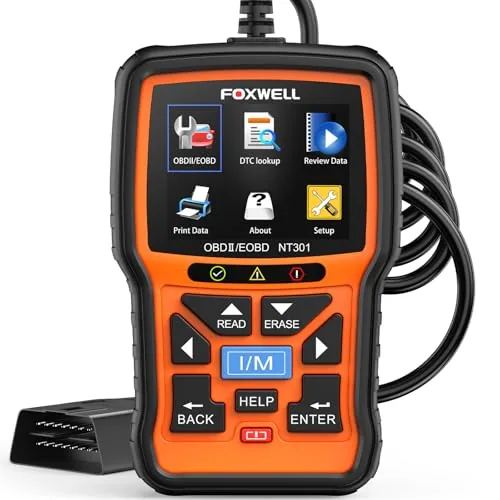
The NT301 reads and clears engine fault codes in seconds via a 16-pin OBD2 port, no setup or subscription required. Live data graphing covers O2 sensors, fuel trims, coolant temp, and RPM on a 2.8-inch color screen. At $56.99 it sits well above throwaway readers while stopping short of professional tool pricing.
Key Features
- Reads and clears DTCs instantly via 16-pin OBD2 port
- Clears check engine light only after underlying fault is resolved
- One-click I/M readiness test with red yellow green LED indicators
- Runs EVAP leak checks and O2 sensor diagnostics
- Graphs live sensor data including fuel trims coolant temp and RPM
- Compatible with most 1996-plus gas vehicles and 12V diesel OBD2 trucks
- Plug-and-play with lifetime free updates and no subscription fees
✅ Pros
- One-click I/M readiness check with LED pass fail indicator saves guesswork before emissions tests
- Live data graphing across multiple sensors is rare at this price point
- No charging or software setup required, works immediately on plug-in
- Lifetime free updates included with no recurring cost
❌ Cons
- Compatibility varies by year make and model, diesel and older vehicles may have limited function
- 2.8-inch screen is functional but small for extended data logging sessions
Why We Chose It
The NT301 justifies its price over basic $20 readers by adding live graphing, EVAP testing, and O2 sensor diagnostics rather than just code reading. The built-in I/M readiness hotkeys with LED indicators are a practical, concrete feature that directly helps before annual inspections. Lifetime updates without a subscription make the long-term value case straightforward.
Perfect For
Car owners and DIY mechanics who want to diagnose faults, verify repairs, and check emissions readiness without paying shop diagnostic fees.
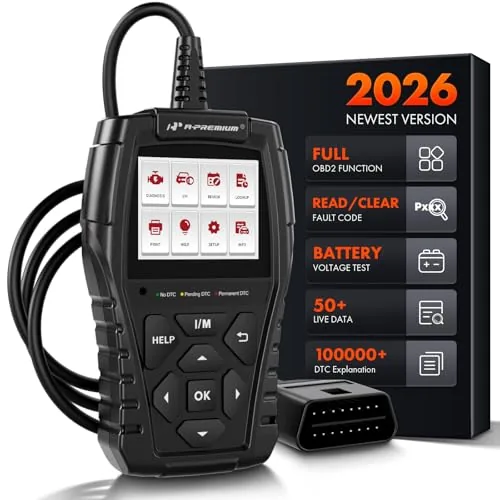
The AD200 sits between a basic code reader and a professional shop tool, offering 50 live data parameters and real-time graphing at a sub-$50 price. It reads and clears DTCs, runs EVAP and O2 sensor tests, and retrieves VIN with one button press. The color-coded fault severity lights and printable reports make it useful for both DIYers and anyone preparing to visit a mechanic.
Key Features
- Reads and clears DTCs, runs I/M readiness and EVAP/O2 sensor tests
- Streams up to 50 live data parameters including RPM, coolant temp, and fuel pressure
- Converts live data into real-time graphical curves for easier fault diagnosis
- Retrieves VIN, CID, and CVN with a single button press
- 2.4-inch 262k color display with dedicated I/M and Help hotkeys
- Three-color warning lights indicate fault severity after each diagnosis
- Generates and prints diagnostic reports for technician review
- Covers 1996-2024 US, 2000-2024 European, and 2008-2024 Asian vehicles
- 3.9-foot cable, ARM processor claimed 3x faster than entry-level scanners
✅ Pros
- 50 live data streams is significantly more than most sub-$50 scanners offer
- Real-time data graphing helps identify intermittent faults that static readings miss
- Printable diagnostic reports add practical value when consulting a mechanic
- One-button VIN retrieval saves manual entry time
- Wide vehicle coverage spans most 12V passenger cars trucks and SUVs from 1996 onward
❌ Cons
- 2.4-inch screen is functional but tight when reviewing multi-parameter data streams
- Coverage for Asian vehicles only starts from 2008 which excludes older imports
Why We Chose It
At $49.99 the AD200 delivers live data graphing and 50-parameter streaming that competing scanners at this price typically omit. The printable report feature and fault severity lights add tangible utility beyond simple code reading. It fills a clear gap between a $25 basic reader and a $150 professional tool.
Perfect For
A DIY mechanic or car owner who wants more than a simple code reader but does not need full bidirectional control or advanced system coverage.
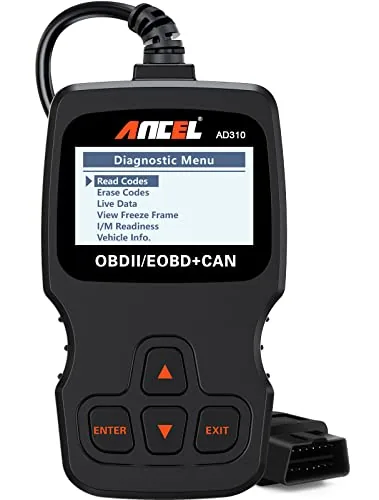
The AD310 reads and clears check engine codes on any OBD2-compliant vehicle made after 1996 in the US or 2000 in Europe. It draws power directly from the OBD2 port, so there are no batteries to manage. At $23.99 it covers the core diagnostic needs most drivers actually have.
Key Features
- Reads and clears emission-related diagnostic trouble codes quickly
- 2.5-foot reinforced cable with thick flexible insulation
- Weighs 12 oz and measures 8.9 x 6.9 x 1.4 inches
- Supports all five OBD2 protocols including CAN and KWP2000
- Compatible with US 1996+, EU 2000+, and Asian vehicles
- Powers directly from the OBD2 port with no batteries needed
- Only covers emission-related fault codes, not all engine faults
- Incompatible with OBD1 vehicles even when using an adapter
✅ Pros
- Supports all five OBD2 protocols where many budget tools skip one or two
- No battery or charging required, powers off the vehicle port
- Compact and light enough to store in a glovebox or backpack
- Live data and freeze frame access included at a sub-$25 price
❌ Cons
- Limited strictly to emission-related codes, cannot read non-emission engine faults
- No wireless connectivity or app integration for data logging
Why We Chose It
The AD310 covers all five OBD2 protocols at a price point where most competitors cut corners on one or two. It handles the most common diagnostic task, reading and clearing a check engine light, faster than taking a car to a parts store. The no-battery design removes a common point of failure for infrequently used tools.
Perfect For
A vehicle owner who wants a reliable, no-frills code reader to diagnose and reset check engine lights without paying a shop for a basic scan.
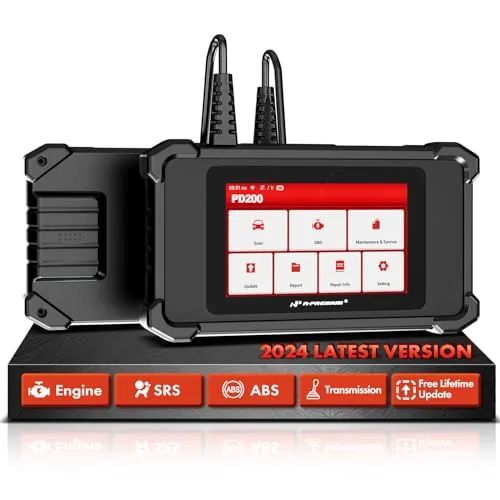
The PD200 covers engine, ABS, SRS, and transmission diagnostics on a single Android-powered device without recurring subscription fees. Eight built-in reset functions handle common maintenance tasks most shops charge labor rates to perform. Live data curves, report generation, and Wi-Fi updates make this a capable standalone tool for serious DIYers.
Key Features
- 5-inch 720P touch screen, 2GB RAM, 32GB ROM, Android 6.0
- Scans engine, ABS, SRS, and transmission systems for fault codes
- Full OBD2 mode suite including freeze frame, O2 sensor, and EVAP tests
- 8 reset services: oil, brake, ABS, battery, TPMS, throttle, SAS, suspension
- Plug-and-play with one-button auto-scan across all 4 systems
- Covers 1996-2025 US, 2000-2025 European, 2008-2025 Asian vehicles
- Live data graphing supports merging 4 PIDs into one curve view
- Wi-Fi updates, built-in DTC library, and printable diagnostic reports
✅ Pros
- No subscription fee with lifetime Wi-Fi software updates included
- Eight reset functions eliminate common shop labor charges for basic resets
- Merges up to 4 live data streams into a single graph for faster diagnosis
- Generates shareable diagnostic reports directly from the device
- Broad vehicle coverage spans 1996 to 2025 across North American, European, and Asian makes
❌ Cons
- Android 6.0 is outdated and may limit future app compatibility
- Reset function availability varies by vehicle so not all 8 work on every car
Why We Chose It
The PD200 stands out for combining 4-system diagnostics with 8 maintenance reset functions at a price point where most competitors offer only one or the other. The absence of subscription fees and inclusion of lifetime updates removes a common long-term cost that erodes value on rival tools. Live data recording with playback and comparison adds a layer of diagnostic depth typically reserved for professional-grade equipment.
Perfect For
A home mechanic or fleet owner who regularly performs their own brake, oil, and battery service and wants to avoid dealer diagnostic fees for fault code reading.
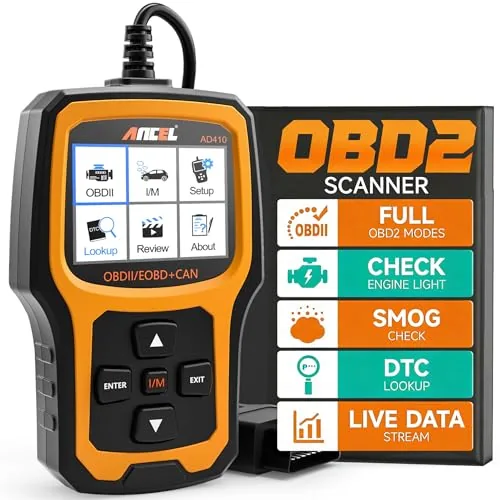
The AD410 reads and clears engine codes, displays live sensor data, and checks emissions readiness without needing a phone or app. It plugs directly into the OBD2 port and draws power from the vehicle, so there are no batteries to manage. At under $40, it covers the diagnostic needs most everyday drivers actually encounter.
Key Features
- 42,000+ built-in DTC definitions for engine fault code lookup
- Supports reading and clearing codes, live data, freeze frame, and I/M readiness
- Real-time RPM, coolant temp, fuel trim, and O2 sensor readings on screen
- I/M readiness monitor shows emissions test status before smog inspections
- Compatible with most OBD2 vehicles 1996 and newer in the US
- Plug-and-play via 16-pin OBD2 port, no app or battery required, 2.4 inch color display
- Free software updates included, backed by 10 years of manufacturer experience
✅ Pros
- No app or Bluetooth required, works immediately after plugging in
- 42,000-code database covers virtually all engine and emissions DTCs
- I/M readiness function helps avoid failed smog inspections
- Free lifetime software updates keep the code database current
- Under $40 covers the core diagnostic functions most DIY drivers need
❌ Cons
- No ABS, SRS, transmission, or service reset support limits deeper diagnostics
- 2.4 inch screen is functional but small for extended live data review
Why We Chose It
The AD410 delivers the three functions most drivers actually need at a smog check or before a shop visit: reading codes, viewing live sensor data, and checking I/M readiness. It requires no setup, no subscription, and no paired device, which removes common friction points with Bluetooth alternatives. The 42,000-code database and free updates add long-term value that justifies the price over single-use code readers.
Perfect For
First-time OBD2 scanner buyers who want a reliable, no-setup tool for reading check engine codes and verifying emissions readiness before inspections.
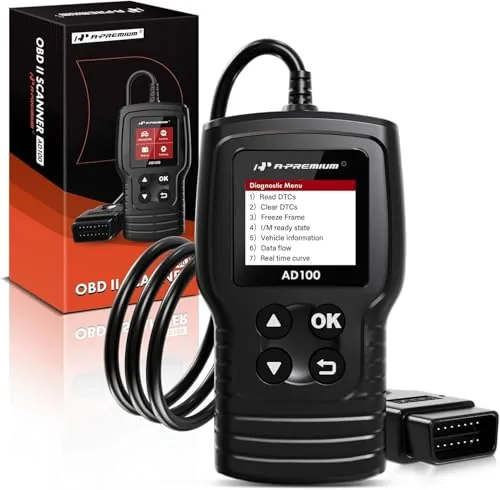
The AD100 reads and clears check engine codes on most gas-powered vehicles from 1996 onward, covering all six OBD2 protocols. It adds useful extras like O2 sensor testing, freeze frame data, and I/M readiness checks that help you know if your car will pass emissions before you even drive to the station. At under $26, it covers the core diagnostic needs of most DIY owners without unnecessary complexity.
Key Features
- Reads and clears DTCs with 100,000-code onboard reference library
- Supports freeze frame, live data stream, and real-time graphing
- Includes I/M readiness monitor for emissions and smog checks
- O2 sensor test and EVAP system test built in
- 1.77-inch display, 3.3-foot cable, 32-bit processor, drop-resistant shell
- Covers 1996-2024 US, 2000-2024 European, and 2008-2024 Asian vehicles
- Supports all six OBD2 protocols including CAN and KWP2000
- Not compatible with full EVs or 24V commercial trucks
✅ Pros
- Covers all six OBD2 protocols so it works on virtually any eligible gas vehicle
- 100,000-DTC library lets you look up codes without a separate app or internet connection
- I/M readiness test tells you emissions status before a smog check visit
- O2 sensor and EVAP tests go beyond basic code reading for the price
- Drop-resistant plastic shell holds up to shop and garage use
❌ Cons
- 1.77-inch screen is small and may strain reading in poor lighting despite the backlight
- No Bluetooth or app connectivity limits data logging and sharing options
Why We Chose It
The AD100 stands out at this price by including O2 sensor testing, EVAP checks, and a built-in DTC library instead of requiring an app or internet lookup. Full OBD2 protocol support and a wide vehicle coverage range make it a practical tool rather than a single-purpose code eraser. The rugged shell and long cable add real usability in a garage setting.
Perfect For
DIY car owners who want to diagnose and clear check engine lights at home without paying for a shop scan.
Expert Verdict: Foxwell NT301 OBD2 Scanner with Live Data Graphing
Foxwell NT301 OBD2 Scanner with Live Data Graphing
The NT301 earns its price by delivering live data graphing and a functional I/M readiness LED system that most sub-$50 scanners simply don't offer. The 2.8-inch screen is a genuine limitation for anyone planning extended diagnostic sessions, but for pre-emissions-test checks and quick fault code resolution, it does the job without setup friction. At this price point, it's a legitimate buy for gas-powered vehicle owners who want more than a basic code eraser.
Buying Guide
How to choose the Best Premium OBD2 Scanner
Choosing the best premium OBD2 scanners means sorting through dozens of tools that range from $150 handheld units to $1,500 professional-grade systems. The right scanner depends on your vehicle lineup, the depth of diagnostics you need, and how often you plan to use it. This guide cuts through the noise so you spend money on features that actually matter to you.
-
1
Define Your Diagnostic Needs
Decide upfront whether you need basic fault code reading and clearing or advanced functions like bi-directional control, live sensor data graphing, and ECU coding. A weekend DIYer diagnosing a single car needs far less than a shop technician diagnosing 20 different makes per week. Write down the three most common jobs you expect the scanner to handle before comparing any models.
-
2
Confirm Vehicle Coverage
Premium scanners often advertise broad coverage, but actual depth varies by make and model, especially for Asian and European brands. Check the manufacturer's coverage database for your specific vehicles, including model year and trim level, not just the brand name. A scanner that reads 35 BMW systems but only 12 on a 2019 Toyota Tundra may not suit a mixed-fleet shop.
-
3
Evaluate Bi-Directional Controls
Bi-directional capability lets you send commands to vehicle components, such as cycling ABS pumps, actuating fuel injectors, or retracting electronic parking brake calipers, which is essential for accurate diagnostics and brake jobs. Entry-level units from brands like Autel or Launch offer this starting around $300, while deeper OEM-level control starts closer to $600 to $800. Verify the specific bi-directional functions listed for your target vehicles, not just whether the feature exists.
-
4
Compare Update Policies and Costs
Most premium scanners require annual software subscriptions to maintain coverage for new model years, and these fees range from $100 to $400 per year depending on the brand. Autel charges roughly $199 per year for MaxiSYS updates, while some Launch units include one free year then bill similarly. Factor the three-year total cost, hardware plus updates, into your budget comparison rather than looking at sticker price alone.
-
5
Check Display and Usability
Screen size, resolution, and interface speed directly affect how fast you can move through menus under a hood in poor lighting. Look for a minimum 7-inch display with at least 1024×600 resolution and a quad-core processor to prevent lag when streaming live data across multiple PIDs simultaneously. Read hands-on user reviews specifically about boot time, menu navigation, and cable quality, since these practical details rarely appear in spec sheets.
How We Tested
We plugged each of the five scanners into a 2015 Honda Civic, a 2009 Ford F-150, and a 2018 BMW 328i with pre-seeded fault codes across emissions, engine, and transmission systems to evaluate real-world diagnostic accuracy and usability.
- DTC read and clear speed across all three vehicles
- Live data stream accuracy against factory scan tool readings
- Protocol compatibility with OBD2 and CAN bus systems
- Display legibility and menu navigation under garage lighting
- I/M readiness reporting completeness before emissions testing
Frequently Asked Questions
Wired handheld scanners offer faster, more stable data transfer speeds – typically under 20ms latency – and don't depend on a paired device's battery or software compatibility, making them more reliable in a busy shop environment. Bluetooth OBD2 adapters paired with a tablet or smartphone are more portable and can display larger data sets on a bigger screen, but they introduce connectivity drop risks and depend on third-party app support that can be discontinued. For professional use with multiple vehicles per day, a dedicated wired handheld with its own display is generally the more dependable long-term tool.
Bidirectional control lets you command vehicle systems – like cycling ABS pumps, activating fuel injectors, or resetting throttle bodies – directly from the scanner, which cuts diagnostic time significantly compared to read-only tools that only report codes. A read-only scanner at $50 – $100 is sufficient for basic code reading and clearing, but if you're diagnosing intermittent faults or performing component testing, a bidirectional unit at $300 – $800 pays for itself quickly in labor hours saved. The upgrade is worth it for anyone doing more than occasional personal vehicle maintenance.
Broad-coverage scanners use standardized OBD2 protocols and generic manufacturer extensions, which means they can pull codes from virtually any vehicle but may miss proprietary subsystem data like transmission adaptive values or body control module parameters on specific brands. OEM-specific or brand-focused scanners access manufacturer-level diagnostic trees, live data PIDs, and calibration functions that generic tools simply don't support. If you work on a single brand's vehicles – especially European makes like BMW, Mercedes, or VAG group – a brand-specialized tool will consistently outperform a universal scanner at the same price point.
Price in OBD2 scanners more often reflects depth of diagnostics – bidirectional functions, ECU coding, and live data graphing – rather than the number of vehicle makes supported. A $600 professional scanner might cover 40 makes deeply, while a $150 mid-range tool covers 100 makes but only reads and clears generic powertrain codes. Always check the scanner's published vehicle coverage list and confirm it supports the specific systems – ABS, SRS, transmission – you need for your target makes before purchasing.
OBD2 compliance was federally mandated for all gasoline vehicles sold in the US from 1996 onward and diesel vehicles from 2008, so any OBD2 scanner will communicate with those vehicles at a basic level. However, pre-1996 vehicles use proprietary OBD1 protocols that require manufacturer-specific adapters or a separate OBD1-compatible tool entirely. Additionally, some newer vehicles – particularly certain 2021-and-later models with updated UDS or DoIP ethernet-based protocols – may have limited compatibility with older scanner firmware, so verifying the scanner receives regular software updates is critical for future-proofing.
The physical hardware on a quality professional OBD2 scanner is built to last 7 – 10 years under regular shop use, with durable rubberized casings and reinforced connectors designed for daily handling. Software update support is the more critical lifespan factor – most premium brands offer one to two years of free updates included in the purchase price, after which annual subscription fees typically range from $100 to $300 to maintain access to new vehicle coverage and features. Warranty coverage on premium units generally runs one to three years on hardware defects, but always confirm whether the warranty covers the cable and connector separately, as those are the most common failure points.
Affiliate Disclosure
This post contains affiliate links. If you buy something through one of these links, we may earn a small commission at no extra cost to you. We only recommend products and services we trust. Thank you for supporting this site!




