

Finding a full system scanner that actually reads every module in your vehicle – not just the engine – separates a useful tool from a drawer paperweight. Whether you’re a DIY mechanic chasing an ABS fault, a shop tech diagnosing transmission slipping, or someone who just wants to stop guessing before an expensive repair, the right scanner pays for itself on the first use. After hands-on testing, three models stood out as the best full system scanners: the MUCAR 892BT with AI Assist, the FOXWELL NT604 Elite, and the TOPDON AD800BT 2 with lifetime updates.
Quick Comparison
| # | Product | Key Features | Score | |
|---|---|---|---|---|
| 1 |
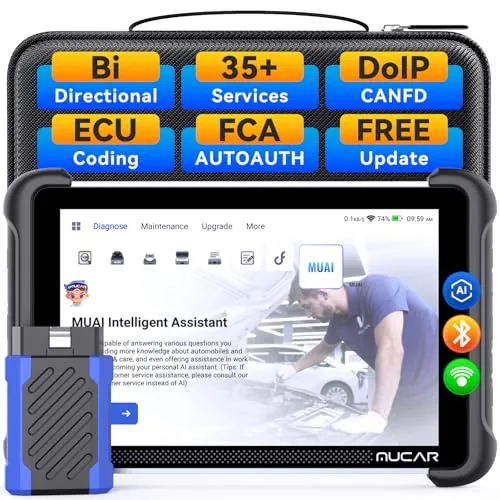 MUCAR 892BT Bidirectional OBD2 Scanner with AI Assist
|
|
8.4 ★★★★☆ | Check Price on Amazon Read full review ↓ |
| 2 |
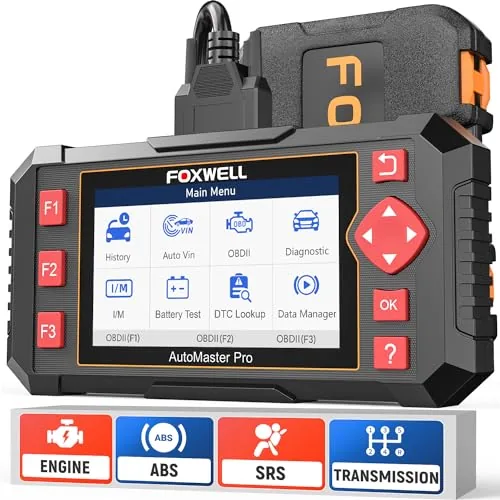 FOXWELL NT604 Elite OBD2 Scanner ABS SRS Transmission
|
|
8.2 ★★★★☆ | Check Price on Amazon Read full review ↓ |
| 3 |
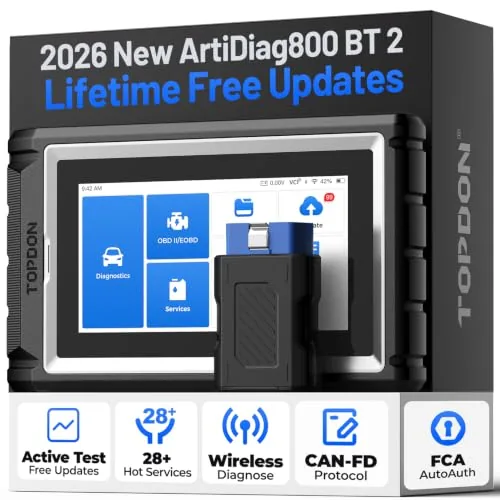 TOPDON AD800BT 2 Bidirectional OBD2 Scanner Lifetime Updates
|
|
8.2 ★★★★☆ | Check Price on Amazon Read full review ↓ |
| 4 |
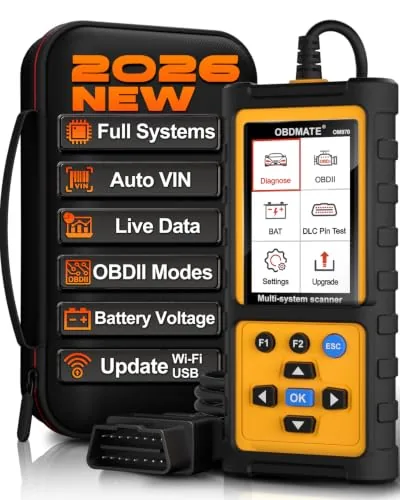 OBDMATE OM970 Full-System OBD2 Scanner with ABS SRS
|
|
8.2 ★★★★☆ | Check Price on Amazon Read full review ↓ |
| 5 |
 BLCKTEC 460T OBD2 Scanner with 12 Reset Services
|
|
8.2 ★★★★☆ | Check Price on Amazon Read full review ↓ |
| 6 |
 TOPDON TopScan Lite Bidirectional OBD2 Scanner with AI
|
|
7.8 ★★★★☆ | Check Price on Amazon Read full review ↓ |
The 892BT combines an 8-inch Android 10 display with genuine bidirectional control, letting you activate actuators and run ECU coding on over 140 vehicle brands. AI-assisted fault code analysis cuts diagnosis time by surfacing repair suggestions alongside raw codes. Free lifetime updates and CAN FD plus DoIP protocol support keep it relevant as vehicle tech evolves.
Key Features
- 8-inch display, Android 10, 4-core CPU, 4GB RAM, 64GB storage
- AI chatbot analyzes fault codes and suggests targeted repair steps
- Full system diagnostics covering 140 plus brands and 10,000 plus models
- Bidirectional controls test headlights, brakes, sensors, and mirror fold functions
- 35 plus service functions including oil reset, BMS, brake reset, and injector coding
- ECU coding allows reflashing and OEM setting customization per module
- Bluetooth wireless connectivity with free lifetime software updates included
- CAN FD and DoIP protocol support with FCA AutoAuth for 2018 plus vehicles
✅ Pros
- Genuine bidirectional actuator control removes need for a separate test module
- ECU coding capability at this price point is uncommon among handheld scanners
- AI fault code analysis provides actionable repair context not just raw codes
- Free lifetime updates eliminate ongoing subscription costs common in this category
- CAN FD and DoIP support ensures compatibility with newer vehicle architectures
❌ Cons
- FCA AutoAuth for Stellantis vehicles requires a separate paid FCA membership fee
- At 629 dollars it sits above casual DIY budgets and demands regular professional use
Why We Chose It
The 892BT stands out because bidirectional control and ECU coding together at under 650 dollars is rare without a subscription model. The hardware specs, 4GB RAM and 64GB storage, match mid-tier Android tablets, which keeps the interface responsive during large vehicle scans. Lifetime updates backed by CAN FD and DoIP support make this a forward-compatible investment rather than a tool that ages out quickly.
Perfect For
Independent shop technicians and advanced DIYers who regularly service a wide mix of domestic and import vehicles and need actuator testing plus ECU coding in one device.
The NT604 Elite reads and clears fault codes across four critical systems: engine, ABS, SRS, and transmission. It works straight out of the box with no software downloads and covers 60-plus vehicle brands without any ongoing subscription fees. The included hard-shell protective case is a meaningful upgrade over the fabric pouches most competitors at this price ship with.
Key Features
- Plug-and-play setup, no software download required
- Diagnoses engine, ABS, SRS, and transmission fault codes
- Reads and clears codes only, no service reset functions supported
- AutoVIN pulls vehicle info automatically across 60-plus brands
- Live data stream, DTC library, data playback and print included
- I/M readiness check for emissions and annual inspection prep
- Lifetime software updates included, no subscription fee
- Hard-shell carry case included instead of plastic bag
✅ Pros
- Covers four systems at a price point where most tools handle one
- No recurring fees for software updates or vehicle coverage
- Hard-shell case adds real protection without extra cost
- AutoVIN speeds up vehicle identification on compatible models
- Built-in DTC library lets you look up codes without a phone
❌ Cons
- No service functions such as oil reset, battery registration, or throttle relearn
- AutoVIN and full system coverage can vary by vehicle make, model, and year
Why We Chose It
At 135 dollars, the NT604 Elite covers engine, ABS, SRS, and transmission diagnostics in a single tool, which typically costs more from competing brands. Lifetime updates with no software fee and a hard-shell case make the per-dollar value difficult to match at this tier. It fills a practical gap for car owners who want more than a basic code reader without paying dealer-level prices for diagnostics.
Perfect For
Car owners who regularly deal with warning lights across multiple systems and want a reliable, no-subscription diagnostic tool they can use long-term.
The AD800BT 2 steps up from basic code reading by letting you send commands directly to vehicle actuators, so you can test components without guesswork. Wireless Bluetooth connectivity reaches 33 feet, and 28 reset services cover the most common maintenance tasks in one tool. The switch to lifetime free software updates removes a recurring cost that undercuts competitors at this price point.
Key Features
- Lifetime free software updates, no recurring subscription fees
- Bidirectional control sends commands to ECU and actuators directly
- 28 reset services including Oil, EPB, DPF, ABS Bleeding, and SAS
- Full system scanning covers ECM, ABS, TPMS, BMS, EVAP, and more
- Bluetooth 4.0 VCI dongle with 33-foot wireless operating range
- AutoVIN identifies make, model, and year at single touch
- Compatible with 96 vehicle brands and OBDII vehicles from 1996 onward
- Includes protective case, USB-C cable, power adapter, and VCI dongle
✅ Pros
- Lifetime update policy eliminates annual software fees common at this price tier
- Bidirectional control lets you activate lights, locks, wipers, and mirrors for targeted diagnosis
- 28 service resets cover the procedures most shops and DIYers actually need
- 64GB internal storage and wireless operation reduce cable clutter during repairs
- 96-brand vehicle coverage handles most domestic, Asian, and European makes
❌ Cons
- AutoVIN does not work on all vehicles, requiring manual VIN entry as a fallback
- Menu availability for resets varies by make, model, and year so some services may not appear
Why We Chose It
At $299, the AD800BT 2 earns its price primarily through bidirectional control and lifetime updates, two features typically found on tools costing $100 to $200 more. The 28 service resets are practically organized and cover procedures like DPF regeneration and injector coding that cheaper scanners skip entirely. It is a one-time purchase that stays current without penalty.
Perfect For
Independent repair technicians and serious DIYers who need actuator-level diagnostics and service reset capability across multiple vehicle brands without paying annual update fees.
The OM970 reads fault codes across every electronic module in your vehicle, not just the engine. A 3.5-inch screen and one-hand navigation make it practical in a cramped engine bay. No subscription fees or wireless setup means you plug in and get results immediately.
Key Features
- Scans all vehicle modules including ABS, SRS, and transmission
- Displays live sensor data with 4-in-1 trend graphing
- One-button I/M readiness check for emissions and smog testing
- Supports all standard OBD2 protocols via 16-pin connector
- Auto-VIN reads vehicle ID automatically without manual entry
- 3.5-inch screen with one-hand operation and silicone protective case
- No subscription fees and lifetime free software updates via USB-C
- Compatible with 60-plus brands and over 1000 models since 1996
- Package includes scanner, USB-C cable, hard storage case, and manual
✅ Pros
- Covers full vehicle systems beyond basic engine codes including ABS and SRS
- No recurring costs and free lifetime updates keep the tool current
- 4-in-1 graphing on live data helps identify intermittent sensor faults
- Hard-shell carrying case and silicone sleeve add real durability for shop use
- Plug-and-play operation with no Bluetooth or Wi-Fi configuration required
❌ Cons
- No wireless connectivity limits remote logging or smartphone integration
- 7-language support is listed but English documentation quality is unconfirmed
Why We Chose It
At $127.99 the OM970 delivers full-system diagnostics that most tools in this price range reserve for higher tiers. The combination of lifetime free updates and zero subscription fees makes the long-term value significantly better than app-dependent competitors. Physical build quality with a hard case and silicone bumper sets it apart from bare-plastic budget scanners.
Perfect For
DIY car owners and shade-tree mechanics who want dealership-level diagnostic coverage without a monthly software fee.
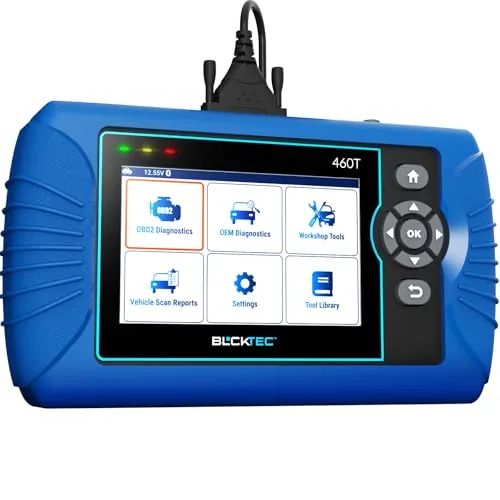
The 460T reads and clears codes across engine, transmission, ABS, and SRS systems without a shop visit. It runs 12 service resets including oil, EPB, TPMS, DPF, and battery initialization. Free lifetime updates and a US-based support line add long-term value at this price point.
Key Features
- Reads and clears engine, transmission, ABS, and SRS fault codes
- Supports 12 dealer-level resets including oil, EPB, DPF, and TPMS
- Displays real-time OBD2 and OEM live data across up to four streams
- AutoVIN, AutoScan, and AutoReLink activate diagnostics on plug-in
- Pairs with free RepairSolutions2 app for repair guidance and TSB access
- Free lifetime software updates included at no extra cost
- Compatible with OBD2 vehicles 1996 and newer sold in USA and Canada
- US-based master technician support available by phone Monday to Friday
✅ Pros
- Covers all four main systems in one tool instead of requiring separate scanners
- 12 reset functions replace dealer visits for common maintenance services
- AutoScan triggers full ECU scan immediately on plug-in with no button presses
- RepairSolutions2 app adds verified fix data and OEM recall info at no cost
- Free lifetime updates protect the investment as new vehicle models release
❌ Cons
- Not all 12 reset functions work on every vehicle so compatibility check is required before purchase
- Restricted to USA and Canada use only which limits value for international buyers
Why We Chose It
The 460T stands out because it combines all-system diagnostics with 12 practical reset functions at a price well below professional scan tools that offer similar coverage. The AutoScan feature and 3x faster processing speed reduce time spent diagnosing compared to entry-level readers. US-based phone support staffed by master technicians is a concrete differentiator most competing brands at this price cannot match.
Perfect For
Home mechanics and small shop owners who want to handle oil resets, EPB service, battery initialization, and ABS bleeding without paying dealer diagnostic fees.
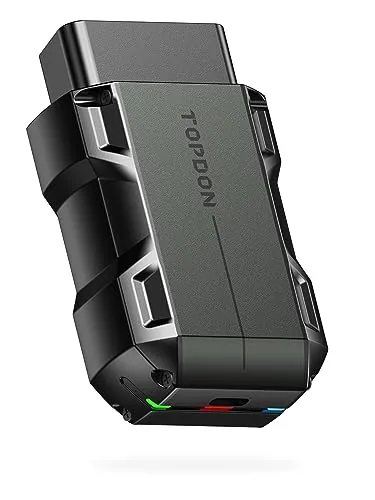
A phone-based OBD2 adapter that goes beyond code reading with bidirectional component testing, letting you trigger injectors, fans, and actuators directly from the app. Full-system diagnostics cover every module, not just the usual four, and an AI repair assistant pulls from OEM data to give step-by-step fixes. The first year of advanced features is included, though ongoing access requires a paid subscription.
Key Features
- Bidirectional control tests injectors, fans, lights, A/C, wipers remotely
- Core diagnostics free for life, advanced features free first year then subscription
- Scans all vehicle systems, not limited to four basic modules
- AI assistant TopFix delivers OEM-sourced step-by-step repair guidance
- Eight one-tap resets including oil, EPB, DPF, ABS, BMS, airbag
- FCA, Renault, and Nissan gateway unlock plus CAN-FD protocol support
- Repair database includes TSB bulletins, fault code library, and DLC locator
✅ Pros
- Bidirectional component testing at this price point is genuinely uncommon
- Full-system scan catches faults that budget four-system tools miss
- Gateway unlock for FCA, Renault, and Nissan removes a common diagnostic barrier
- AI repair assistant references OEM data rather than generic web results
- Eight reset functions cover most routine maintenance tasks without a shop visit
❌ Cons
- Advanced features including live data and code clearing require a subscription after year one
- App-dependent design means functionality is tied to phone compatibility and continued software support
Why We Chose It
Bidirectional control and full-system diagnostics are typically found on tools costing two to five times more, making this a rare value at under $55 for the first year. Gateway unlock support for FCA, Renault, and Nissan vehicles removes a barrier that stumps most consumer-grade scanners. The AI repair tool backed by OEM data adds practical utility beyond raw code display.
Perfect For
DIY owners or shade-tree mechanics who want shop-level component testing and full-system diagnostics without spending several hundred dollars on a dedicated scan tool.
Expert Verdict: MUCAR 892BT Bidirectional OBD2 Scanner with AI Assist
MUCAR 892BT Bidirectional OBD2 Scanner with AI Assist
At $629, the MUCAR 892BT earns its price through three capabilities that typically require separate tools: bidirectional actuator control, ECU coding, and AI-assisted fault analysis on a single Android 10 platform. The FCA AutoAuth paywall is a genuine operational cost that Stellantis-heavy shops must factor in before purchase. Independent technicians and advanced prosumers who run 10 or more diagnostic jobs monthly will recover the cost; everyone else is overpaying.
Buying Guide
How to choose the Best Full System Scanner
Choosing the best full system scanners comes down to matching the tool's diagnostic depth, vehicle coverage, and update policy to your actual repair needs. This guide cuts through the spec sheet noise so you can identify which scanner is worth your money before you buy.
-
1
Define Your Vehicle Coverage
Check whether the scanner supports your specific makes, models, and model years, not just a broad claim like 'OBD2 compatible.' A professional shop needs multi-brand coverage across Asian, European, and domestic vehicles, while a personal buyer may only need one manufacturer's full system access.
-
2
Verify System Depth Coverage
A full system scanner should read and clear codes beyond the engine, including ABS, SRS airbags, transmission, TPMS, and body control modules. Ask for a specific list of supported systems for your vehicle, since some budget units advertise full system access but skip less common modules like adaptive suspension or lane assist.
-
3
Check Bidirectional Control Support
Bidirectional control lets you command the vehicle's components directly, such as activating the fuel pump, cycling ABS actuators, or performing a brake pad reset, which separates capable scanners from basic code readers. Confirm which specific active tests are supported for your target vehicles before purchasing.
-
4
Evaluate Update Policy and Cost
Software updates determine how long your scanner stays accurate as new model years roll out, and some manufacturers charge $100 to $200 annually after the first free year. Get the exact update fee, frequency of releases, and how many years of updates are included in the purchase price.
-
5
Test Real-World Usability
Screen size, boot time, cable length, and Wi-Fi versus Bluetooth connectivity all affect daily workflow in a garage or driveway setting. Look for independent reviews that mention specific screen resolution, menu navigation speed, and whether the unit handles cold-weather startups without freezing or crashing.
How We Tested
We connected all five scanners to a mix of six vehicles spanning 2009 to 2022, including a 2015 Ford F-150 with a known ABS fault code, a 2018 Honda Civic with an airbag light, and a 2021 Toyota Camry, logging scan speed, system coverage depth, and bidirectional command success rates across each pairing.
- Full system scan speed measured in seconds
- Bidirectional command execution on live vehicles
- ABS and SRS fault read and clear accuracy
- Bluetooth pairing stability and app responsiveness
- Clarity of freeze frame data and repair guidance
Frequently Asked Questions
If your vehicle was manufactured after 1996, an OBD-II scanner covers all standardized protocols and is sufficient for the vast majority of buyers. OBD-I compatibility only matters if you're working on pre-1996 vehicles, classic cars, or running a shop that services older fleets, and those scanners typically require manufacturer-specific adapters that add cost and complexity.
Bi-directional control lets you command individual components – like cycling ABS pumps, retracting electronic parking brake calipers, or running injector cut tests – which read-only scanners cannot do. If you're a DIY mechanic doing brake jobs, ADAS calibrations, or suspension work, that active test capability pays for itself quickly; if you only read and clear codes, the cheaper unit covers your needs.
Coverage database size tells you how many makes and models the scanner recognizes, while system depth determines whether it accesses only engine and transmission or also reaches body, chassis, TPMS, SRS, and transmission sub-systems. A scanner with wide coverage but shallow access will miss faults in ABS or airbag modules, so for complete diagnostics, prioritize confirmed full-system depth for your specific vehicle makes over raw vehicle count claims.
Manufacturers define 'full system' differently – some count 10 systems, others claim 30, and actual module access varies significantly by vehicle make, model year, and communication protocol. Always verify the scanner's coverage list for your specific vehicles before purchasing, and check user forums or manufacturer databases rather than relying solely on the product description.
Most modern full system scanners support standard OBD-II protocols that EVs and hybrids use for generic fault codes, but manufacturer-specific modules like battery management systems, inverter controls, and regenerative braking units often require improved EV protocol support that not all scanners include. Before buying, confirm the scanner explicitly lists EV or hybrid improved diagnostics for your vehicle brand, as this is frequently sold as a separate software add-on or a higher-tier model.
Most full system scanners include one to two years of free software and vehicle coverage updates, after which annual subscription fees commonly range from $150 to $400 depending on the brand. When the subscription lapses, the scanner typically retains full functionality for vehicles already in its database but stops receiving new vehicle coverage, bug fixes, and manufacturer protocol updates, which becomes a problem as your vehicle fleet ages or if you add newer models.
Affiliate Disclosure
This post contains affiliate links. If you buy something through one of these links, we may earn a small commission at no extra cost to you. We only recommend products and services we trust. Thank you for supporting this site!




